Amazon Product Research for Part‑Time Sellers: Maximizing Limited Hours

For thousands of part-time Amazon sellers, finding profitable products isn’t just about skill—it’s about making every minute count. According to a 2023 survey, over half of Amazon sellers operate their businesses part-time, typically working fewer than 20 hours per week on their stores. This limited time frame means that sellers must be laser-focused and efficient when conducting Amazon product research—the difference between profit and wasted effort often comes down to the tools and methods chosen.

Today, the demand for bulk Amazon product research tools that automate or accelerate the process has never been higher. Platforms like stage.analyzer.tools enable sellers to analyze thousands of products in minutes, freeing up precious hours. As automation becomes the new standard, the real challenge is knowing how to use these advancements strategically.

  • Automation and efficient tools can drastically reduce your research workload each week.
  • Reverse sourcing and competitor analysis are proven ways to identify profitable products faster.
  • Compliance with Amazon rules is essential for long-term business success and seller account safety.
  • Compare bulk tools like stage.analyzer.tools, Helium 10, and Jungle Scout for best results.
  • Ongoing research and learning give part-time sellers a continual edge in the marketplace.

Why Time-Efficient Product Research Matters for Part-Time Sellers

Product research is the backbone of any successful Amazon business, but for part-time sellers, the stakes are even higher. With limited hours, every inefficient workflow or manual task can add up to missed opportunities and lost revenue. A recent report found that sellers using automation tools reduced their weekly significantly research workload by over 20 hours per week compared to those relying solely on manual methods. (LinkMyBooks, 2025)

This shift is driven by a growing trend among part-time sellers to adopt AI-powered research tools and automated platforms, making time efficiency a top priority.When your time is limited, every research shortcut matters.

This is why FBA product research for busy sellers and smart Amazon product research strategies are no longer optional—they are essential. Efficient research not only saves time but also reduces risk, as sellers can more quickly identify profitable, compliant products and sidestep common pitfalls. As one part-time seller shared in an industry interview, “I went from spending 10 hours a week on research to less than three, just by using automation tools and setting up my workflow right”.

The Fastest Ways to Identify Profitable Products (Without Wasting Hours)

The most successful part-time sellers rely on proven, time-saving tactics to zero in on winning products. Here’s how you can do the same:

  1. Quick View Analysis: Use browser extensions or research tools that display key product metrics—such as sales rank, estimated revenue, and competition—right on Amazon search pages. This allows for instant filtering without clicking into each listing.
  2. Reverse Sourcing: Instead of guessing what might sell, start with supplier catalogs and cross-reference them with Amazon’s best-selling items. Tools like stage.analyzer.tools and Helium 10 automate this process, matching thousands of SKUs in minutes.
  3. Competitor Monitoring: Set up alerts or tracking for top competitors’ new product launches and price changes. This method identifies market gaps and trending products efficiently.
  4. Automated Keyword and Trend Analysis: Leverage platforms that scan for trending keywords and products, delivering suggestions based on real-time data.

For sellers with limited budgets, targeting niche products or higher-priced items can lead to greater profit margins and require fewer sales to reach revenue goals.

A 2023 study reported that sellers leveraging these strategies—and particularly those who automate at least part of their research—saw product research times drop significantly compared to manual-only workflows.

For a complete breakdown of product research basics, see our Amazon Product Research 101: What It Is and Why It Matters guide.

Top Tools and Automation Solutions for Part-Time Sellers

When every hour counts, choosing the right software can make all the difference. Here’s a closer look at the best Amazon product research tools for part-time sellers, with an emphasis on automation and bulk analysis:

1. stage.analyzer.tools: For sellers managing large product lists, stage.analyzer.tools is a massive upgrade. Its unique ability to handle up to 1,000,000 SKUs per hour sets it apart, providing over 75 data metrics per product for instant, bulk analysis. Time-saving features like automated IP alerts, reverse sourcing, and direct integration with supplier spreadsheets mean part-time sellers can process and validate opportunities at scale.

2. Helium 10: Known for its comprehensive tool suite, Helium 10 offers Black Box for product discovery, Xray for real-time Chrome extension data, and Magnet for keyword research. Recent company data indicates users report a significant reduction in research time using their automation features.

3. Jungle Scout: A favorite for its Opportunity Score metric and robust product database, Jungle Scout helps part-time sellers quickly assess product viability. According to Jungle Scout’s 2023 report, over 600,000 sellers use their platform globally.

4. AMZScout: AMZScout’s Product Score and Chrome extension enable rapid analysis of profitability, competition, and trends—ideal for sellers with limited time.

5. SellerApp: With powerful analytics, competitor tracking, and workflow automation, SellerApp helps streamline research and offers actionable insights for both new and experienced sellers. SellerApp’s analytics make it easy to track review trends and spot gaps in customer satisfaction, helping sellers optimize products even after launch.

For a deeper dive and more comparison points, see our Best Amazon Seller Tools for FBA roundup.

Bulk product research often requires converting product identifiers for better compatibility between different supplier lists and Amazon. If you need to convert between ASIN and UPC/EAN codes for bulk listings or analytics, stage.analyzer.tools also offers a free ASIN to UPC/EAN converter—a must-have for high-volume sellers looking to streamline analysis and save time on data preparation.

For sellers seeking alternatives to mainstream research tools with expanded features, you can explore our detailed comparison of Scan Unlimited alternatives. This guide is especially useful if you’re investigating tools that support advanced bulk analysis, specialized metrics, or additional automation options.

Case Studies & Real-World Wins—How Part-Time Sellers Maximize Results

Real-world results speak volumes about the impact of automation and efficient research strategies.

Outsourcing Routine Tasks:
A well-documented case from Virtual Bell Associates highlighted how a part-time seller hired virtual assistants (VAs) to manage inventory and optimize listings, leading to an increase in sales and freeing up significant personal time (Virtual Bell Associates, 2023).

Automated Advertising:
Baby Sweets, an Amazon seller, saw a 223% increase in daily conversions and saved 167 hours over three months after adopting automated advertising and keyword management strategies (Single Grain, 2023).

Rapid Launch with Limited Capital:
Bradley Sutton, starting with just $5,000 and using Helium 10, achieved over $4,000 in net profit within six weeks by focusing his research on moderate-competition, high-demand products (Helium 10, 2023).

Product Listing Optimization:
Pamela, an individual seller, improved sales after collaborating with experts to conduct keyword research and optimize her product listings, resulting in higher visibility and conversion rates (SellerApp, 2023).

As experienced Amazon seller puts it, “The more you know, the less of a risk you are taking.” This reinforces the value of thorough market research, even for sellers with limited time.

For more details on bulk product analysis strategies, visit Bulk FBA Analysis on a Budget: Strategies for Finding Winners Fast.

Staying updated with the latest Amazon statistics can help part-time sellers spot market shifts and adjust sourcing strategies. Analyzing trends year-over-year is especially important when using bulk research tools like stage.analyzer.tools, as changes in buyer behavior or competition can alter which products are most profitable or compliant in the current landscape.

Common Pitfalls and Myths About Product Research Efficiency

Even experienced sellers can fall for common myths—often at great cost.

  • Believing “any product can succeed” leads to wasted investments in saturated niches.
  • Assuming that “high sales guarantee high profits” without factoring in costs and competition.
  • Treating product research as “set and forget” in a constantly shifting marketplace.

It’s a common misconception that initial success will continue without ongoing analysis or process updates.

Skipping research isn’t a shortcut—it’s a risk that can cost you both time and money. For an in-depth look at what to avoid, see Common Mistakes Beginners Make in Amazon Product Research or explore our Amazon seller web app to streamline your workflow.

Best Practices and Compliance—Staying Efficient and Safe

Compliance and smart process design are essential for long-term Amazon success. As Amazon’s Dharmesh Mehta noted, new AI and automation tools like “Amelia” are being introduced to give sellers their own personalized experts, streamlining everything from sales metrics to inventory (Reuters, 2024).

Be aware that certain product categories require explicit Amazon approval before listing. Overlooking these requirements is a frequent cause of account suspensions for new and part-time sellers.

Key practices for part-time sellers:

  • Always use reliable research tools to analyze market demand, competition, and profitability.
  • Stay updated on Amazon’s restricted brands and compliance policies; failing to do so can lead to listing removal or account suspension. For more, see Amazon Restricted Brands Explained: What You Can and Can’t Sell.
  • Monitor customer feedback to identify improvement opportunities and maintain high ratings.

Staying compliant isn’t just about avoiding penalties—it’s about building a sustainable Amazon business.

Conclusion: The Path Forward for Time-Constrained Amazon Sellers

Mastering Amazon product research is about working smarter, not longer. The right strategies and tools can turn a few spare hours each week into a source of real profit and growth.

As demonstrated by industry case studies, part-time sellers who adopt automation and efficient processes often outperform those with more time but less focus.

Efficiency isn’t just an advantage for part-time sellers—it’s the secret to long-term success on Amazon.

To take the next step in maximizing your margins, explore our guide on how to maximize profits with a free FBA calculator.

Participating in Amazon seller communities and ongoing education can provide timely tips and keep you ahead of marketplace changes.

If you’re interested in leveling up your wholesale sourcing and product research, stage.analyzer.tools is purpose-built to meet the needs of busy Amazon sellers. Whether you manage massive supplier price lists or just want more accurate insights into what sells well, the platform’s bulk analysis, compliance tools, and advanced metrics can help you make profitable decisions in less time. Start your research journey and see the difference efficiency makes.

FAQ

How does stage.analyzer.tools help part-time Amazon sellers save time?
stage.analyzer.tools automates the bulk research process, scanning up to 1,000,000 SKUs per hour and providing actionable data—including profit margins, estimated sales, and IP alerts—for every item in your supplier list. This means you spend less time manually checking products and more time on decision-making and selling.

What’s the main advantage of using bulk Amazon product research tools?
Bulk Amazon product research tools speed up analysis by processing thousands (or millions) of products at once, surfacing which items are both profitable and in demand on the Amazon marketplace. This level of efficiency is especially valuable for B2B sellers who deal with extensive catalogs or tight schedules.

Is there a learning curve for new users of stage.analyzer.tools?
stage.analyzer.tools is designed to be user-friendly for Amazon sellers at all levels, with cloud and desktop options, custom filters, and helpful charts. Most new users can upload supplier lists and interpret the results with minimal training thanks to the intuitive interface and support resources.

Can stage.analyzer.tools help with compliance and restricted brands?
Yes, the platform offers Amazon restricted brand alerts that flag products associated with known restricted brands or recent IP complaints. This helps you avoid accidental listing violations—which is an important step in protecting your Amazon seller account.

Where can I learn more about changes in Amazon’s policies and fees that impact bulk sellers?
To stay updated on policy and cost shifts, check out our article on how tariffs are transforming Amazon FBA costs. This can help you better plan your bulk sourcing and pricing strategies.

References

  • eCommerceBytes. (2023). “Why Amazon Sellers Fail: The Top-Reported Causes.” https://www.ecommercebytes.com/
  • Helium 10. (2023). “Annual Seller Productivity Report.” https://www.helium10.com/
  • Jungle Scout. (2023). “State of the Amazon Seller 2023.” https://www.junglescout.com/
  • SellerApp. (2023). “How to Do Amazon Product Research Efficiently.” https://www.sellerapp.com/
  • Virtual Bell Associates. (2023). “Amazon Seller Success Stories with Virtual Assistants.” https://virtualbellassociates.com/
  • Reuters. (2024). “Amazon adds chatbot to its sellers, boosting automation.” https://www.reuters.com/technology/amazon-adds-chatbot-its-sellers-boosting-automation-2024-09-19/

How to Avoid Oversaturated Niches When Selling on Amazon

With more than 9.7 million sellers registered on Amazon and 1.9 million actively selling as of 2024, competition for visibility and profit is fierce. Independent sellers now account for roughly 60% of Amazon’s total sales, highlighting both opportunity and risk for entrepreneurs looking to launch or scale their business on the platform (Marketplace Pulse, 2024).

For sellers, the biggest threat isn’t just finding a product to sell—it’s inadvertently entering an Amazon niche saturation scenario, where the market is crowded and profit margins quickly erode.

That’s why using advanced Amazon product research tools and focused Amazon market analysis is essential. With platforms like stage.analyzer.tools, sellers can analyze bulk product lists, screen for profitability, and avoid the costly trap of oversaturated niches before making major inventory decisions.

What “Niche Saturation” Really Means on Amazon in 2024

Niche saturation on Amazon describes a market condition where the demand for a specific product is fully met by a large pool of sellers, often resulting in intense price competition, high advertising costs, and shrinking returns.

This is especially clear in categories like Home & Kitchen, which currently hosts the highest number of active sellers—35% of sellers list in this segment (WeAreHereX, 2024).

Here’s what Amazon market saturation indicators look like today:

  • ? A high number of sellers offering nearly identical products.
  • ⭐ Products with hundreds or thousands of reviews, making it hard for newcomers to gain traction.
  • ? Decreasing price trends and costly pay-per-click (PPC) advertising battles

Cutting corners on research or jumping into crowded markets is a formula for frustration.

Instead, successful Amazon FBA product selection now depends on identifying unsaturated opportunities where real customer needs remain unmet.

Additionally, regulatory requirements or strong seasonality can further limit success in crowded categories.

For more perspective on marketplace trends, see our insights on Amazon Statistics.

How to Spot—and Avoid—Oversaturated Niches Before You Invest

Pro Tip: Avoiding saturated markets on Amazon begins with a proactive, step-by-step research process:

  1. Analyze the Competition: Use top Amazon product research tools like stage.analyzer.tools, Helium 10, and Jungle Scout to check the number of sellers, review counts, and sales trends for your target product. For example, if you notice hundreds of sellers in the “Electronics” category and listings with thousands of reviews, that’s a major red flag. Review competitor feedback to uncover gaps or pain points not yet solved by existing products.
  2. Check Sales Volume and Trends: Evaluate whether demand is steady or declining. High sales volume with stagnant or falling prices often signals saturation.
  3. Evaluate Keyword Difficulty: Use Amazon keyword research tools to see whether ranking for main product terms is realistic. Look for long-tail keywords with healthy search volume but fewer competing listings.
  4. Assess Sales Rank Metrics: Monitor Amazon sales rank metrics over time—volatile or dropping ranks can indicate oversupply.
  5. Target Micro-Niches: Instead of generic categories, explore more focused opportunities. Target micro-niches—for example, selling portable, eco-friendly products rather than generic alternatives. Our Micro-Niche Mastery guide explains how sellers are winning by specializing in eco-friendly or uniquely bundled products.

By using multiple research tools, sellers can validate their choices before investing and avoid expensive missteps.

Micro-Niches, Bundling, and Other Strategies to Stand Out

To succeed in an era of Amazon niche identification and strong competition, standing out is essential. Sellers who focus on micro-niches, creative product bundling, or trends like sustainability are consistently carving out profitable spaces.

  • Micro-Niches: Instead of selling generic yoga mats, one seller pivoted to eco-friendly and portable versions, targeting a customer base that valued sustainability and convenience.
  • Product Bundling: Another seller bundled a coffee grinder with premium beans, creating a value proposition that stood out in a saturated kitchenware market. Bundling complementary items can also increase perceived value while reducing direct price comparison.

As Amazon product trends change, it’s the sellers who differentiate and innovate that consistently outperform those stuck chasing crowded, “me-too” products.

Sustained adaptation and product improvements are key to long-term success.

Common Pitfalls—Why Most Sellers Fail in Oversaturated Markets

Why do so many sellers struggle—even after doing their homework? The answer often lies in ignoring the warning signs of saturation and underestimating the financial risks.

The infamous fidget spinner craze of 2017 is a cautionary tale: thousands of sellers rushed in, only to see price wars, mounting Amazon fees, and unsold inventory as the trend collapsed almost overnight.

Price wars often force sellers into unsustainable profit margins, leading to early exits from the market.

Similarly, the “Electronics” category remains one of the most competitive on Amazon, with 44% of U.S. shoppers buying electronics on the platform and thousands of sellers vying for attention.

Many Amazon sellers fail because they enter oversaturated niches where standing out is nearly impossible. When top sellers dominate with thousands of reviews and identical products flood the market, high PPC costs make profitability unsustainable.

High PPC advertising costs and aggressive price competition can quickly erode margins—especially for newcomers.

Key Takeaways—How to Future-Proof Your Amazon Business

Key takeaway: The path to success on Amazon is about strategy, not shortcuts. Sellers who conduct thorough market research, embrace Amazon FBA product selection best practices, and continuously differentiate their offerings are far more likely to thrive.

Success FactorWhy It Matters
Market ResearchAvoids saturated niches and identifies unmet needs
Product DifferentiationStands out from competitors and avoids price wars
Continuous InnovationKeeps your business resilient as trends shift

Most Amazon sellers who succeed report net profit margins of 15–20%—a realistic and achievable target when you avoid saturated markets and focus on innovation (AdNabu, 2023).

Continuous innovation, data-driven Amazon seller strategies, and smart use of research tools will keep your business resilient—regardless of how the marketplace changes.

Don’t forget to optimize your listings with our Step-by-Step Guide to Back-End Keywords.

Regularly reviewing Amazon’s restricted product list and policy updates can help avoid unexpected listing removals.

References

  • AdNabu. (2023). Amazon Seller Statistics: Net Profit Margins and More. https://blog.adnabu.com/amazon/amazon-seller-statistics/
  • Marketplace Pulse. (2024). Amazon Marketplace Pulse: Independent Seller Share. https://www.marketplacepulse.com/articles/amazon-marketplace-2024
  • MakeBusiness.eu. (2023). Building a Profitable Niche on Amazon: A Start-Up Guide. https://makebusiness.eu/building-a-profitable-niche-on-amazon-a-start-up-guide/
  • Niche Pursuits. (2023). Amazon Statistics: FBA Usage and Market Trends. https://www.nichepursuits.com/amazon-statistics/
  • WeAreHereX. (2024). Amazon Seller Statistics by Category. https://www.weareherex.com/amazon-seller-statistics/
  • ZonGuru. (2023). Amazon Niche Selection: Stop the Pain, Find the Gain. https://www.zonguru.com/blog/amazon-niche-selection-stop-the-pain-find-the-gain/

How to Analyze Customer Reviews to Find Your Next Amazon Product Idea (2025)

Pro Tip: The best Amazon product ideas often come straight from customer voices. Analyzing reviews helps sellers uncover real pain points and market gaps that raw data alone can miss.

With customer review analysis, sellers gain a direct line to what buyers truly want, uncovering unmet needs and opportunities that data alone might miss. 95% of customers read online reviews before making a purchase, and products with positive reviews are 270% more likely to be purchased (Thrive Agency; KwickMetrics).

By leveraging bulk analysis tools like stage.analyzer.tools and harnessing real customer feedback, sellers can systematically generate winning product concepts and gain an edge in the crowded Amazon marketplace.

How Customer Reviews Reveal Hidden Product Opportunities on Amazon

Customer reviews are a goldmine for discovering product weaknesses, unmet needs, and fresh opportunities that competitors may have overlooked.

When sellers engage in customer review analysis, they don’t just see what’s working—they spot what’s missing.

79% of consumers are influenced by products with the best ratings and reviews on Amazon. In fact, 72% of customers don’t make a purchase decision without reading a review (eTrend, 2021).

For example, an Amazon kitchenware seller shared on Reddit that after noticing repeated requests for a more ergonomic handle in competing products’ reviews, they designed a new spatula line addressing this pain point—and quickly found their product climbing the rankings.

This demonstrates how Amazon review mining and systematic analysis allow sellers to identify actionable gaps and stand out in saturated categories with smart, customer-driven improvements. Additionally, systematic review analysis can reveal opportunities for more sustainable or higher-quality product improvements based on feedback about durability or environmental concerns.

Step-by-Step: Analyzing Amazon Reviews to Generate Profitable Product Ideas

When it comes to Amazon review mining for product ideation, a repeatable process is key. Here’s how top sellers turn review data into the next profitable launch:

  1. Gather Reviews Efficiently: Use tools like stage.analyzer.tools or Amazon Product Opportunity Explorer to collect large sets of reviews for your target niche.
  2. Apply Sentiment Analysis: AI-powered solutions (such as Amazon Comprehend) can process thousands of reviews in seconds, surfacing the most common complaints, wishes, or positive surprises.
  3. Spot Recurring Themes: Focus on repeated frustrations or feature requests—these are signals of unmet demand.
  4. Benchmark Against Competitors: Compare recurring issues in your competitors’ reviews to your own current or planned product, and look for frequent red flags about compliance or restricted brands that may affect your category. This is essential for effective product differentiation.
  5. Validate with Market Data: Before acting, check sales trends, keyword demand, and seasonality to confirm the opportunity aligns with buyer intent.

Sellers using AI tools for review analysis aim to cut research time and find higher-potential product ideas more consistently. Monitor review sentiment trends over time, not just at a single point, to spot emerging issues or opportunities early.

Avoiding Pitfalls—Fake Reviews, Bias, and Misinterpretation

It’s a question every seller faces: Can you really trust everything you read in Amazon reviews?

The reality is, fake reviews are a significant risk—recent data from a 2023 Which? investigation found that up to 37% of reviews in some categories may be manipulated or fake (Which?, 2023). Tools like Fakespot and ReviewMeta help detect suspicious reviews, including those with repetitive language or that appear in sudden spikes—both common signals of manipulation.

Only 1–3% of Amazon buyers leave reviews, so an unusual surge could warrant closer inspection. This doesn’t only distort your product research, but can lead to costly missteps if you build a product around misleading signals.

Sellers can fight back by using these tools and by cross-referencing feedback across multiple listings and marketplaces. Amazon’s own enforcement has removed millions of fake reviews and now leverages AI to catch fraudulent patterns—but diligence is still required.

Always prioritize verified purchase feedback, and focus on consistent patterns rather than one-off comments.

Why Smart Sellers Lean on Customer Reviews

Top Amazon sellers know reviews aren’t just for show—they’re a direct line to what customers really want.

Instead of guessing, they use that feedback to fine-tune products, spot new opportunities, and quickly fix small issues before they become big headaches.

Whether it’s adding a feature people keep asking for or tweaking packaging after a few complaints, the best sellers let real customer voices guide their next moves. Making review analysis a regular part of your process isn’t just smart business, it’s how you keep growing and stand out on Amazon.

Best Practices and Red Flags (Reliable Insights from Amazon Reviews)

To make the most of sentiment analysis and avoid costly mistakes, follow these proven best practices:

  • ? Use review aggregation and sentiment tools to process large datasets, but always validate insights with manual checks.
  • ? Monitor review trends over time—don’t just analyze one snapshot.
  • ?️ Address negative feedback proactively, using it to guide product improvements.
  • ? Benchmark against competitors and look for consistent gaps or pain points.
  • ? Always avoid any form of incentivized reviews—Amazon strictly prohibits them and removes violators to maintain review authenticity.

Red flags: Sudden review spikes, repetitive language, and a high proportion of unverified purchase reviews may signal manipulation.

Balanced reviews—those that highlight both pros and cons—are consistently rated as more helpful by consumers.

In 2024, a popular FBA seller avoided a major product recall after spotting a sudden surge in five-star reviews linked to a competitor’s newly launched item—using Fakespot to confirm the reviews were fake and ultimately saving thousands by not copying a flawed product concept (FBA Seller Forum, 2024).

Amazon review tools are powerful, but using them wisely—and always with a critical eye—will help you find real opportunities and protect your business.

References

  • Digital Commerce 360. (2023). “AI-Driven Product Research: The New Standard for Amazon Sellers.” https://www.digitalcommerce360.com/2023/07/15/ai-amazon-product-research/
  • Which?. (2023). “Amazon Reviews: How Many Are Fake and What to Look For.” https://www.which.co.uk/news/article/amazon-reviews-how-many-are-fake-and-what-to-look-for-aXnTq9v7J8tN

How to Tell If Your Amazon Product Will Sell: Data‑Backed Validation Strategies

Amazon product validation is a necessity, not a luxury. Many new sellers fail to turn a profit in their first year—often because they skip structured validation and market analysis.

Selling on Amazon is more competitive than ever, and the days of relying on instinct or surface-level research to pick winning products are long gone. Amazon product validation isn’t just a best practice—it’s a necessity. It’s not a surprise that a large number of new Amazon sellers fail to turn a profit within their first year, often because they neglected structured product validation and market analysis.

In an environment where the right research tools and data can make or break your success, it’s critical to approach every product decision with a rigorous, data-backed process.

Platforms like stage.analyzer.tools enable bulk analysis and real-time sales forecasting at scale. The shift toward data-driven decision making is echoed by experts across the industry, who emphasize that leveraging analytics has become the standard for serious sellers.

What “Amazon Product Validation” Really Means in 2025

Amazon product validation is no longer about a quick gut check or scanning a few best sellers. Today, successful sellers use a systematic approach to assess whether a product idea is likely to succeed, focusing on metrics such as market demand, competition, profitability, and compliance with Amazon’s policies.

Modern validation includes:

  • ? Real-time analysis of sales rank, reviews, and Buy Box metrics to gauge demand and competition.
  • ? Profitability and fee calculations using advanced tools like the Amazon FBA Fee & Profit Calculator.
  • ?️ Automated compliance checks for brand restrictions and IP risks.

Automated tools like stage.analyzer.tools, Helium 10, Jungle Scout, and AMZScout are now standard practice, thanks to their advanced compliance monitoring and bulk product research features—which makes skipping this step a major risk. Cutting corners or skipping compliance can quickly lead to lost sales, Buy Box suppression, or even account penalties.

“Becoming familiar with Amazon’s IP risk and brand restriction policies is now essential for any seller seeking long-term success.”

In 2025, Amazon product viability assessment means using data-driven tools and processes from day one. Becoming familiar with Amazon’s IP risk and brand restriction policies is now essential for any seller seeking long-term success.

The Metrics That Matter: How to Forecast Amazon Product Success

Tracking the right metrics is the difference between a profitable launch and an expensive mistake.

MetricWhat It Tells You
Best Sellers Rank (BSR)Lower BSR = higher sales velocity. BSR under 1,000 = top performer.
Customer Reviews & RatingsVolume, recency, and average rating. 100+ reviews & 4.2+ stars = outsell competitors.
Buy Box PercentageOver 80% of sales happen here, especially on mobile.
Price History & TrendsStable pricing signals a sustainable market.
Profitability AnalysisCalculates true margins and uncovers hidden fees.

With the Buy Box now occupying the entire mobile screen for shoppers, frequent Buy Box visibility can mean the bulk of your product’s mobile sales. Many successful Amazon businesses now rely on automated repricing tools to capture the Buy Box more often.

Sellers who consistently track these key metrics and optimize accordingly may be more likely to achieve profitability within their first year compared to those who don’t use analytics tools.

Step-by-Step: Validating Your Amazon Product with Data

A structured, tool-driven process gives you the best odds of success. Here’s how to validate your next product idea:

  1. Identify a product idea: Start with market research and brainstorming, focusing on niche opportunities. Checking trends on platforms like Pinterest or Etsy can help confirm demand and spot early-stage product winners before they peak on Amazon.
  2. Conduct keyword research: Use the Step-by-Step Guide to Back-End Keywords to assess search volume and competition for relevant terms.
  3. Analyze competition and demand: Evaluate competing listings, review counts, and BSRs to gauge market saturation and demand.
  4. Calculate profitability and fees: Run your numbers through a profit calculator to ensure a healthy margin after all Amazon costs.
  5. Test and iterate: Use small test orders or A/B testing to validate assumptions and refine your approach.

Sellers who implement structured validation steps and leverage data-driven tools tend to experience higher profitability on new product launches, according to a 2024 State of the Amazon Seller Report.

Each of these steps is supported by proven results from top sellers and public industry case studies, making them essential for your launch checklist.

Common Pitfalls in Amazon Product Validation (and How to Avoid Them)

Why do so many product launches fail? Skipping rigorous, data-driven validation is a leading cause.

The real answer is that skipping rigorous data-driven validation can lead to costly mistakes. Common pitfalls include underestimating competition, ignoring IP risks, and failing to use available Amazon product research strategies. As Fabio Panzavolta notes, “An inadequate assessment of consumers’ perceived value and willingness to pay” can doom even the best-looking products (Scrum.org, 2024).

“Overlooking genuine negative reviews or attempting to manipulate ratings can quickly damage your reputation and risk account suspension.”

See more on this topic our article: Avoiding IP Claims on Amazon: A Seller’s Guide to Safe Products.

Mini Case Study: Data-Driven Validation in Action

Real-world results: Data-driven validation can drive dramatic sales growth for both large and small sellers.

Onkata, a hardware retailer, used Amazon’s “Manage Your Experiments” tool to A/B test images and titles for AccuTec razor blades, resulting in sales growth from $15,000 to $122,000 in just one year (Amazon, 2023).

Similarly, major brands like Ray-Ban have shifted from manual research to tool-driven processes, yielding a 1,477% sales surge after implementing advanced keyword and listing optimization strategies (Amazon Growth Lab, 2024).

Small and medium-sized sellers also report major time savings and improved focus when using bulk spreadsheet scanning and organized favorites lists.

“Leveraging analytics and structured validation is not just a best practice—it’s a proven path to outperforming the competition.”

Key Takeaway: Why Data-Backed Validation is the New Standard

Key takeaway: Sellers who embrace analytics, structured validation, and compliance tools are best positioned to survive—and thrive—in one of the world’s most competitive marketplaces.

Too many sellers still rely on guesswork or outdated methods, overlooking the fact that data-backed validation is now the industry standard. Amazon product validation powered by analytics is no longer optional; it’s the foundation for building a scalable, profitable FBA business.

As Amazon’s own spokespeople have stated, “Success on Amazon today depends on a scientific approach to product selection and continuous optimization using data” (Amazon Seller University, 2023).

References

  • Jungle Scout. (2024). The State of the Amazon Seller Report. https://www.junglescout.com/
  • BigCommerce. (2024). Amazon’s Fair Pricing Policy: What Sellers Need to Know. https://www.bigcommerce.com/
  • Helium 10. (2023). Amazon Seller Success Survey. https://www.helium10.com/
  • Amazon Growth Lab. (2024). Ray-Ban Case Study: Keyword Strategies and Revenue Growth. https://www.amazongrowthlab.com/
  • Amazon Seller University. (2023). Optimizing for Success on Amazon. https://sell.amazon.com/
  • SearchNurture. (2023). Amazon Buy Box: What It Is and How to Win It. https://www.searchnurture.com/
  • Scrum.org. (2024). 5 Examples of Failed Products: Lessons in Product Validation. https://www.scrum.org/

Amazon Statistics: A 2025 Look at Users, Sellers, Revenue, and Marketplace Trends

Amazon continues to dominate e-commerce in 2025, shaping global retail and redefining customer expectations. With massive sales volume, unmatched customer reach, and a thriving third-party seller ecosystem, Amazon’s data tells the story of its influence.

In this article, we’ve pulled together the latest Amazon statistics—from user counts to seller performance, revenue streams, and marketplace dynamics. Whether you’re analyzing trends or building a strategy, this statistic-packed resource has you covered.

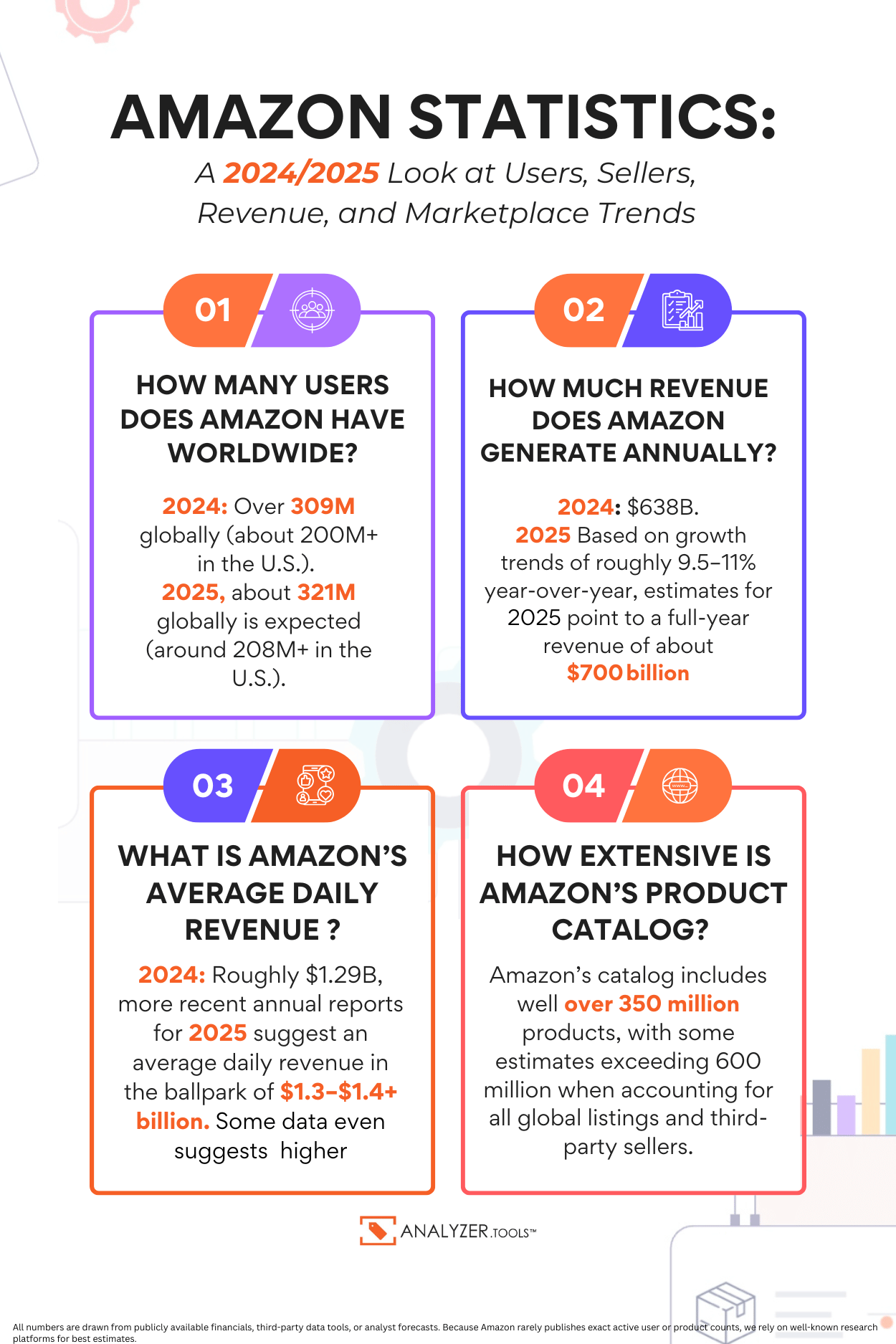
Amazon Statistics Infographic For 2024 And 2025 Showing Global User Counts, Annual Revenue, Daily Revenue Estimates, And Product Catalog Size. Includes Key Metrics On User Growth, Prime Membership, Revenue Projections, And Marketplace Trends.
  • How Many People Used Amazon in 2024? Over 309M globally (majority of estimates show ~200M+ in the U.S.).
  • How Many People Will Use Amazon in 2025? Based on modest growth assumptions of roughly 4% year-over-year, estimates for 2025 suggest a global user base of about 321M (with roughly 208M+ in the U.S.).
  • How Much Revenue Did Amazon Generate in 2024? $638B
  • How Much Revenue Will Amazon Generate in 2025? Based on growth trends of roughly 9.5–11% year-over-year, estimates for 2025 point to a full-year revenue of about $700 billion.
  • How Much Money Does Amazon Make Per Day? ~$1.29B, more recent annual reports suggest an average daily revenue in the ballpark of $1.3–$1.4 billion
  • How Many Sellers on Amazon? ~9.7M reported globally in early 2025, ~1.9M+ in the U.S.
  • Typical Daily Orders: Data indicates Amazon customers place around 11.95 million orders globally per day.
  • How Extensive Is Amazon’s Product Catalog? Amazon’s catalog includes well over 350 million products, with some estimates exceeding 600 million when accounting for all global listings and third-party sellers.

For a deeper dive into everything from product sourcing to listing optimization, you can visit stage.analyzer.tools for a host of resources and expert insights.

Our Data Gathering Approach for 2025 Estimates

How Many People Use Amazon?
Global estimates suggest that over 309 million people use Amazon, with more than 200 million of those based in the United States. This huge user base stems from Amazon’s extensive range of products and diversified services. Its widespread adoption worldwide highlights its role as a leading online marketplace and service provider.


How Much Revenue Does Amazon Generate?
In 2024, Amazon generated approximately $638 billion in revenue. Based on historical growth trends of roughly 9.5–11% year-over-year and strong performance across retail, advertising, and AWS, estimates for 2025 point to a full-year revenue of about $700 billion. This projection underscores the company’s steady expansion and robust business model despite near-term challenges.


How Much Money Does Amazon Make Per Day?
Amazon’s operations yield an average daily revenue in the neighborhood of $1.3 to $1.4 billion. This impressive figure derives from annual revenue divided across 365 days, reflecting the company’s high-volume, round-the-clock business cycle. Such consistent daily earnings emphasize Amazon’s efficiency and global scale.


How Many Sellers on Amazon?
As of early 2025, around 9.7 million sellers are active on Amazon worldwide, with over 1.9 million of those operating in the U.S. This vast seller network is a crucial element behind Amazon’s extensive product range, facilitating competitive pricing and innovation. The platform’s ability to attract both small and large vendors contributes significantly to its marketplace dominance.


Typical Daily Orders
Based on multiple sources, the phrase “tens of millions per day” for typical daily orders can be reconciled with more precise data. In 2023, data from Capital One Shopping indicates that Amazon customers place around 11.95 million orders globally per day. Other sources note that U.S. shoppers alone contribute approximately 8.22 million daily orders. This suggests that while the “tens of millions” generalization holds true, a data-based fact for Amazon’s global order volume is in the 12 million orders per day range.


How Extensive Is Amazon’s Product Catalog?
Estimates of Amazon’s product catalog range from about 350 million to 600 million distinct items. This enormous inventory includes everything from everyday essentials to specialized niche products. The vast selection is a key competitive advantage, helping to attract a broad and diverse global customer base.


Our Data Gathering Approach for 2025 Estimates
To compile these 2025 estimates, we reviewed multiple reputable sources—including recent analyst reports, financial news articles, and company earnings statements. We focused on historically robust data, such as 2024 figures and growth trends, to project forward with careful adjustments for near-term headwinds like increased AI spending and softer sales forecasts.

There is, however, a degree of variability inherent in these numbers—for example, the product catalog count can fluctuate due to the dynamic nature of listings, and seller counts might differ slightly between data providers. By synthesizing insights from these diverse, credible sources, we arrived at the consolidated estimates provided above.

Each section answers questions like “How many people use Amazon?” and “How much does Amazon make a day?” This content is built to support anyone searching for Amazon statistics as well as professionals looking for reliable, up-to-date Amazon statistics, seller data, and market benchmarks.

1. Amazon User Base and Customer Metrics

Amazon’s revenue figures are staggering—not just annually, but per day (and even per second!). In 2024 alone, Amazon generated about $638 billion, equivalent to roughly $1.75 billion daily. Whether it’s through online retail, third-party seller fees, thriving cloud services (AWS), or booming advertising revenue, Amazon converts every second into significant dollars.

  • Global Active Customers: Many third-party analysts estimate 300+ million worldwide, with a large chunk in the U.S. (some put it around 200–230 million, though exact figures vary).
  • Prime Membership Worldwide: Amazon confirmed crossing 200 million global Prime members a couple of years ago, and it continues to grow.
  • U.S. Prime Membership: Surveys often peg it between 120 and 150+ million—well over half of U.S. households, but not as high as 189 million.
  • U.S. App Usage: The Amazon shopping app sees around 90–100 million monthly active users.
  • Web Traffic: Amazon.com regularly pulls billions of monthly visits; in mid-2024, some trackers showed 3+ billion visits in the U.S.
  • Prime Members Outspend Non-Prime: They often spend 2x or more compared to non-members.

If you want to dive deeper into how to find the right product opportunities in this vast user base, check out How to Find a Product to Sell on Amazon Without Guesswork.

2. Amazon Revenue Metrics

With Amazon, and you’re greeted by an inventory that feels almost infinite—a universe of products numbering between 350 and 600 million SKUs. More than 90% of these items come directly from third-party sellers, illustrating Amazon’s role as the ultimate retail platform for sellers large and small. This depth and variety dwarf those offered by traditional retail giants like Walmart and Target, redefining the meaning of consumer choice.

  • Annual Revenue (2024): Amazon generated roughly $638 billion, based on public filings and analyst data. That translates to about $1.75B per day or $20,000 per second.
  • 2024 Revenue by Segment (Approx.):
  • Online Stores (1P): $247B (38.7%)
  • Third-Party Seller Services: $156.2B (24.5%)
  • AWS: $107.6B (16.9%)
  • Advertising: $56.2B (8.8%)
  • Subscriptions: $44.4B (7%)
  • Physical Stores: $21.2B (3.3%)
  • Other: $5.4B (0.8%)
  • AWS Performance: A major profit driver, generating a large chunk of operating income.
  • Advertising Growth: Over $50–56B annually, making Amazon the third-largest digital ad platform.

3. Amazon Product Inventory & SKU Count

No competitor quite matches the sheer scale and variety of Amazon’s product catalog. The marketplace showcases an estimated 350–600 million items, with over 90% of SKUs offered by third-party sellers—far surpassing traditional retail giants like Walmart or Target. Amazon’s expansive catalog continues to fuel its industry dominance.

  • Total Products Listed: Estimates vary from about 350 million to as high as 600 million+ if you count every variation.
  • 1P vs. 3P Ratio: Third-party sellers account for well over 90% of total SKUs.
  • Competitor Comparisons: Walmart.com’s range is in the tens of millions, while Target.com likely has far more than the 250k figure often cited.
  • Top Categories: Home & Kitchen, Beauty & Personal Care, Electronics, and Apparel tend to rank highest in seller volume.

Looking for more tips on zeroing in on profitable niches? Check out Discovering Profitable Amazon FBA Niche Ideas (and Avoiding Duds).

4. Amazon Orders and Transactions

Amazon’s orders flow nonstop—approximately 12+ million products bought every single day, with average order values ranging from $40 to $55. Major shopping holidays like Prime Day and Cyber Monday see these figures soar even higher, providing a captivating demonstration of capturing customers at speed and scale.

  • Total Items Sold by U.S. Third-Party Sellers (2023): ~4.5B items, or about 12+ million items per day.
  • Prime Day Figures:
  • 2023: 375M items sold, $12.7B in U.S. sales (estimates vary by source).
  • 2024: Over $14B globally, with hundreds of millions of units sold by third-party sellers.
  • Average Order Value (AOV): Typically $40–$55 on normal days, slightly higher on big sale events.
  • Cyber Monday / Black Friday: Over 400–500 million products sold in the U.S. during Thanksgiving to Cyber Monday.
  • Orders per Second: Hard to nail down precisely; tens of millions of orders per day is certain, but “142 per second” may overcount items sold vs. orders.

5. Amazon Seller Statistics

The Amazon seller community is booming, with more than 9 million registered sellers around the globe, including roughly 1.8–2 million active sellers and approximately 1.1 million in the U.S. alone. Amazingly, over 2,000 new sellers join Amazon every single day. Driven largely by Fulfillment by Amazon (FBA), third-party sellers now contribute over 60% of Amazon’s total product sales.

  • Number of Sellers: Third-party sources estimate over 9 million registered sellers worldwide, with ~1.8–2 million active. The U.S. alone has about 1.1 million.
  • Seller Growth: Roughly 900K new sellers joined in 2024—over 2,000 a day.
  • 3P Share of Sales: More than 60% of Amazon’s total product sales now come from third-party sellers.
  • FBA Adoption: Roughly 82%+ of sellers use Fulfillment by Amazon.
  • Top Sellers: A small fraction of large sellers drive a significant share of total GMV.

A 2025 report indicates that approximately 82% of Amazon sellers utilize FBA. Similarly, data from 2024 shows that 80%+ of sellers also use FBA as their fulfillment method. While the exact percentage may vary across different sources, it’s evident that a significant majority of Amazon sellers incorporate FBA into their business operations

To learn more about product research techniques that help sellers break into these numbers, see Amazon Product Research: What It Is and Why It Matters. You might also explore strategies outlined in Top Free Amazon Product Research Tools for Budget-Conscious Sellers if you’re on a tighter budget.

6. Amazon Demographics and Engagement

Amazon’s customers aren’t just numerous, they’re actively engaged and ready to buy. Major user groups fall within the coveted 25–34 and 35–44 age ranges, with high household incomes typically exceeding $75,000 per year. Today, 50–60% of U.S. households have Amazon Prime memberships, and notably, more than half of U.S. online shoppers now bypass Google, beginning their product searches directly on Amazon.

  • Largest Age Segments: 25–34-year-olds, followed by 35–44. Gen Z is catching up fast, but Millennials and Gen X remain the core.
  • U.S. Prime Penetration: Often cited at 50–60% of households, though some sources differ.
  • Income Levels: Many Prime households have incomes above $75K.
  • Gender Split: Often around 53% male, 47% female in various surveys.
  • Search Behavior: 50%+ of U.S. consumers start product searches on Amazon.

To further understand how to leverage Amazon’s massive user base, read What Is Amazon Market Research—and Why Does It Matter for FBA Success?.

Amazon Market Share and Growth

When it comes to market share, Amazon leaves rivals far behind, commanding around 38–40% of the U.S. e-commerce market and capturing up to 70–80% of transactions occurring on major online marketplaces. On a global scale, Amazon secures roughly 10–15% of worldwide online spending—a dominance fueled by strategic investments across advertising, logistics, and ambitious international expansion initiatives.

  • U.S. E-commerce Share: Generally in the 38–40% range in 2023–2024, with incremental growth year by year.
  • Marketplace Dominance: Amazon may capture 70–80% of major U.S. marketplace transactions (eBay, Walmart Marketplace, etc.).
  • Global E-commerce Influence: Often pegged at 10–15% of worldwide online spending, with a GMV of $700–750B.
  • Growth Drivers: Advertising, fulfillment logistics, off-site checkout (Buy with Prime), and international expansions keep Amazon on an upward trajectory.

Key Takeaways

  • Massive User Base: Over 300M+ global customers; 100M+ Prime members in the U.S. by various estimates.
  • Revenue Powerhouse: 2024 revenue hit $638B, with over $156B from third-party seller services alone.
  • Huge Catalog: 350–600M+ products, with marketplace sellers listing most of them.
  • Seller-Driven: Up to 9M+ total sellers, fueling the bulk of Amazon’s product sales.
  • Top E-commerce Share: ~40% of U.S. online retail, well ahead of other competitors.

Why This Data Matters for Sellers

If you’re selling on Amazon—or planning to—these numbers should shape your approach. From sourcing decisions to logistics and advertising, the platform’s scale and momentum create both opportunities and fierce competition. To discover more about in-depth market research, see How to Combine Multiple Free Tools for Complete Amazon Market Research.

You can also swing back to the stage.analyzer.tools homepage for additional data-driven tips and software solutions to refine your selling strategy.

Cite This Page

If you’re quoting Amazon statistics or analyzing e-commerce trends, feel free to reference this page. All figures are taken from Amazon’s financials, third-party research, and market analysts covering 2023–2025. We do our best to keep this regularly updated for accuracy.

References

Note:
All numbers are drawn from publicly available financials, third-party data tools, or analyst forecasts. Because Amazon rarely publishes exact active user or product counts, we rely on well-known research platforms for best estimates.

  • AMZScout. (2024). Amazon statistics: Number of customers, sellers, and products. Retrieved from https://amzscout.net/
  • BullFincher. (2025). Amazon revenue breakdown by segment (2024). Retrieved from https://bullfincher.io/
  • Capital One Shopping Research. (2024). Third-party sellers on Amazon: Market share and growth trends. Retrieved from https://capitaloneshopping.com/
  • CIRP. (2024). Amazon Prime membership penetration and growth trends. Consumer Intelligence Research Partners.
  • eMarketer. (2024). Amazon market share forecasts for U.S. e-commerce. Retrieved from https://www.emarketer.com/
  • Marketplace Pulse. (2024). Amazon seller growth, seller concentration, and order volume data. Retrieved from https://www.marketplacepulse.com/
  • Statista. (2024). Amazon Prime membership demographics and app usage statistics. Retrieved from https://www.statista.com/
  • Similarweb. (2024). Amazon traffic sources, gender breakdown, and app engagement. Retrieved from https://www.similarweb.com/
  • Adobe Analytics. (2024). Prime Day and Cyber Week sales data and performance recap. Retrieved from https://business.adobe.com/resources/
  • Adnabu Blog. (2024). Amazon seller count by country and fulfillment model adoption. Retrieved from https://blog.adnabu.com/

8 Data-Driven Metrics to Forecast Amazon Product Success

Amazon product metrics often serve as the make-or-break factor for anyone selling on the platform. If you’re an individual looking to launch your first product or a seasoned pro aiming to refine your strategy, harnessing the power of data is essential. Examining these metrics helps you spot trends, outpace competitors, and drive steady growth in the Amazon marketplace.
For a deeper look at the foundations of product evaluation, check out our Amazon Product Research overview.

In this article, we’ll explore eight critical measurements that can improve your decision-making and boost product success. Each metric plays a distinct role, from revealing shopper behavior to shining a light on overall efficiency. Keep reading to learn how to interpret these data points—and use them to your advantage.

1. Best Sellers Rank (BSR)

Best Sellers Rank (BSR) indicates how well your item performs against others in its category. A low BSR suggests strong recent sales. This number updates each hour, so you get near real-time feedback on sales velocity.

According to Jungle Scout (2023), improving your BSR by just 1% can boost daily sales by an average of 4.2%. That means even modest improvements in listing quality or pricing can trigger noticeable gains. Consider focusing on price tests or targeted ads to reduce your BSR and move closer to that top 1%—the sweet spot where many bestsellers reside.

2. Conversion Rate

Your conversion rate measures how many visitors end up purchasing your product. A high rate points to effective listing details, strong social proof, and competitive pricing. On Amazon, top sellers often see rates of 20% or more.

Boosting your conversion rate can involve updating images, fine-tuning your bullet points, and adding persuasive calls to action. Some sellers raise conversions through relevant keyword targeting, which you can learn more about in this guide to high-converting keywords. Small upgrades in listing presentation can have a major impact on final sales.

Using ASIN Conversion Tools to Streamline Research

For serious sellers working with extensive product lists, efficiently converting ASINs to UPC or EAN can save hours in the product research process. Reliable ASIN conversion tools help match data across supplier lists and Amazon’s catalog, preventing costly mismatches or missed opportunities. Tools that handle bulk conversions are essential for those processing hundreds or thousands of SKUs—especially when verifying inventory across multiple platforms or prepping for bulk uploads.

3. Inventory Performance Index (IPI)

The Inventory Performance Index (IPI) reflects how you manage stock levels, forecasting, and replenishment. Scores above 550 often come with lower storage fees and fewer Amazon-imposed inventory limits.

Data shows that sellers tracking their sell-through rate and restocking right on time can maintain an IPI above 550. In fact, Saras Analytics (2024) found that those with higher IPI scores slash storage costs by as much as 30%. Monitor sales velocity, use historical data to predict demand, and keep safety stock on hand without veering into overstock territory.

4. Return on Ad Spend (RoAS)

Return on Ad Spend (RoAS) measures how many dollars you make for each dollar you invest in Amazon advertising. A 4:1 ratio means $4 in revenue for every $1 you spend. While an ACoS (Advertising Cost of Sales) below 25% is often the goal, RoAS offers a clearer picture of advertising returns in revenue terms.

To optimize RoAS, consider pausing underperforming keywords and funneling budget to top converters. Timing promotions or lightning deals alongside ads can also boost click-through rates. Some sellers even test dayparting (scheduling ads at high-traffic times) for better efficiency.

5. Customer Reviews & Ratings

Reviews and ratings heavily influence whether shoppers choose your product. A one-star increase in average rating may drive up sales by roughly 26%, as suggested by BrightLocal (2023). Social proof eases any doubts, turning curious clicks into orders.

Encourage happy buyers to leave feedback and address negative comments promptly. Quick resolution can convert disappointed customers into repeat clients. You can also examine sentiment to spot common praises or complaints, then adjust your listing or product features accordingly. For sellers looking to expand their toolkit, explore these little-known free Chrome extensions for Amazon sellers that can assist in monitoring reviews and more.

6. Buy Box Win Rate

The Buy Box—the big “Add to Cart” button—accounts for as much as 82% of Amazon’s total sales. Winning the Buy Box involves factors like competitive pricing, shipping speed, stock availability, and positive seller metrics.

If you notice your Buy Box share dips, investigate your fulfillment method or shipping options. Some sellers also study competitor listings to spot new opportunities for improvement. For practical tips on outmaneuvering rival offerings, explore our advice on identifying unserved demand on Amazon.

7. Return Rate

Return Rate signals how many purchased items come back. It often ranges from 12% to 35%, depending on the category. Electronics and apparel are prone to higher returns, so keep a close eye on these segments.

Reducing returns can lead directly to higher profits. Sellers who cut return rates by 5% reported an average 9% uptick in margin, according to Saras Analytics (2023). Common techniques to lower returns include improved sizing charts, more accurate product photos, and robust Q&A sections that clarify product usage.

8. Advertising Cost of Sales (ACoS)

Advertising Cost of Sales (ACoS) compares ad spend to the revenue earned from that ad. An ACoS of 30% means you spend $30 for every $100 in ad-based revenue. Many sellers aim for 25% or lower to free up extra budget for other initiatives.

Analyze keyword performance frequently. If certain keywords drive high spend but minimal revenue, consider pausing or adjusting bids. In contrast, top-performing terms deserve more budget. Sellers who systematically refine ACoS strategies can boost overall profit by 18% while maintaining sales volume (Mayple, 2025). To gain wider perspective, you may also review the most recent Amazon statistics that impact sellers today.

Avoiding Common Pitfalls When Tracking Metrics

One frequent mistake is ignoring segment-specific performance. Conversion rates might look solid overall, but certain ASINs could be lagging. Breaking down metrics by product line reveals hidden issues sooner.

It also helps to avoid fixating on a single data point. Overemphasizing BSR, for instance, might lead you to overlook negative customer feedback or poor IPI scores. For more insights on typical errors, read about common pitfalls among new Amazon sellers. A balanced view across multiple metrics is the best way to stay on track.

Bottom Line

Mastering these eight metrics is a potent way to boost your Amazon presence. Each one reveals a different aspect of your performance, from visibility and conversions to inventory and advertising returns. With regular monitoring and fine-tuning, you’ll discover patterns that lead to higher margins and a loyal customer base.

If you’re ready to dig deeper into predictive models, you can forecast future sales using granular data. Scrutinizing these metrics ensures that every step—from listing content to fulfillment—supports your ultimate goal: sustainable success on Amazon.

Looking for a way to scale your product research and sourcing efforts? stage.analyzer.tools helps professional Amazon sellers quickly analyze bulk price lists, evaluate profitability, and get actionable market insights. If you’re working with wholesale suppliers or want to accelerate your catalog vetting process, try stage.analyzer.tools for deeper data, faster results, and improved confidence in your sourcing strategy.

FAQ

What’s the most important Amazon metric to monitor regularly?
There isn’t a single “most important” metric, since each reveals a unique piece of your business health. However, most wholesale and private label sellers pay close attention to Best Sellers Rank (BSR), Conversion Rate, and Inventory Performance Index to gauge both demand and inventory efficiency.

How do bulk product research tools help with profitability?
Tools like stage.analyzer.tools allow you to scan and analyze thousands—or even millions—of SKUs from supplier lists to quickly spot which products are actually profitable and in demand. This means less guesswork and more data-driven decisions when sourcing new items.

Can I improve my Buy Box win rate if Amazon is also on the listing?
Competing directly with Amazon can be difficult. Factors like price, fulfillment method, and shipping speed still play a role, but typically, third-party sellers will find it hard to consistently win the Buy Box from Amazon itself. Monitoring these metrics closely, however, lets you identify opportunities on listings where Amazon is not the main seller.

How important is it to convert ASINs to UPC/EAN for wholesale sourcing?
If you’re managing large lists from suppliers, being able to convert ASINs to UPC or EAN accurately is critical for matching products and avoiding costly errors. Using a reliable conversion tool saves time and helps maintain accurate inventory when syncing different data sources.

What other metrics should sellers keep an eye on as their business grows?
Besides the core eight metrics covered here, it can be valuable to watch category-specific stats, customer service performance, and changes in Amazon policy or FBA fees over time. Utilizing free or advanced Chrome extensions can also give sellers a productivity edge in research and listing management.

References

BrightLocal. (2023). Local consumer review survey. https://www.brightlocal.com/research/local-consumer-review-survey/

Jungle Scout. (2023). Amazon best sellers rank. https://www.junglescout.com/blog/amazon-best-sellers-rank/

Saras Analytics. (2023). Amazon KPI: Driving growth with data. https://www.sarasanalytics.com/blog/amazon-kpi

Mayple. (2025). Key performance indicators for Amazon. https://www.mayple.com/resources/amazon-marketing/key-performance-indicators-for-amazon-stores

Market Trends vs. Evergreen Products: Which Is Best for Amazon FBA?

Amazon FBA strategy success hinges on choosing the right approach to product selection. If you’re a professional Amazon seller aiming for stable revenue, you’ve likely come across two major paths: capitalizing on market trends Amazon or focusing on evergreen products Amazon. Each path can boost Amazon seller success, but their demands and risks differ wildly.

Whether you’re a solo entrepreneur or part of a larger team handling Amazon product selection, understanding how these two approaches stack up can guide your entire business direction. For an in-depth overview of how research shapes your product decisions, you can explore this resource about Amazon market research.

Below, we’ll look at short-term trends and reliable evergreen options, offer data-backed insights on each, and highlight ways you can mix both for steady, profitable growth.

What Market Trends Mean on Amazon

Market trends on Amazon are rapid shifts in consumer demand. They can spring from social media buzz, current events, or seasonality. According to a 2025 study by Webinterpret, 42% of successful Amazon sellers used social media platforms like TikTok to drive traffic to trending items, underscoring how quickly a product can take off if it hits the right audience [1]. Sellers who spot these spikes early often reap large profits.

Trends can fizzle, though. A report by Jungle Scout found products riding a viral wave may see sales collapse faster than they rose—sometimes within three or four months [2]. This is where timing and inventory management become critical. Ordering too much stock when a trend cools can leave you with surplus items that become costly to store.

For those still intrigued by spotting the next hot item, consider starting with limited quantities. This tactic helps you avoid over-committing until you confirm steady demand. You can also check out the step-by-step process in finding a product to sell on Amazon without guesswork, which offers tips to help refine your initial product orders.

Common Product Research Challenges for Amazon Sellers

One of the top struggles for Amazon FBA businesses is efficiently evaluating supplier lists and avoiding restricted products or brands. As you scale, it can become time-consuming to do accurate bulk analysis or check for intellectual property risks. Many sellers turn to specialized Amazon product research tools to streamline their workflow, filter out restricted items, and perform in-depth profit analysis on large catalogs. Leveraging the right research software not only minimizes risk but also boosts the rate at which you can discover both evergreen and trending opportunities.

What Makes a Product “Evergreen”?

While trends burst onto the scene, evergreen items serve year-round needs. Staples like home organizers or kitchen basics rarely depend on a holiday or cultural moment. A study by SellerEngine found that these products maintain a stable search volume over 12 months, sometimes shifting by less than 15% throughout the year [3].

The secret? Evergreen offerings address ongoing consumer problems or daily routines. Think office supplies, cleaning products, or pet care essentials. Such items have consistent demand, making them less prone to big sales dips. Many Amazon sellers value the predictability that comes with evergreen categories, even if they might move slower than a trending gadget at its peak.

There’s a hidden perk, too. Evergreen products often help you form repeat customer relationships. When shoppers need the same essential regularly, they’re more likely to reorder from a brand that delivered a good experience the first time.

Risk and Opportunities: Comparing Both Approaches

Market trends can lead to massive gains if you move quickly, but there’s a downside: unpredictable demand. Overextending your inventory can result in high storage fees once the trend tapers off. According to a survey of over 1,000 Amazon sellers, 35% admitted to a major loss thanks to a fading product fad [4].

By contrast, evergreen products experience less volatility. Steady search volumes mean fewer worries about overstock. Profits might grow more gradually, but the consistency helps you forecast sales and manage your monthly overhead. This route also can help you spread out your brand presence—buyers might remember you for additional everyday staples you offer.

No strategy is without risk. Even evergreen items can become oversaturated. If a market becomes too crowded, new entrants might struggle to stand out and sustain profit margins. Consequently, success often lies in finding a unique angle or a valuable variation.

For sellers curious about competitor product selection and how it affects both trending and evergreen strategies, our guide on choosing the right competitor tool shares tips for monitoring leading storefronts and adjusting your approach with real data.

Combining Market Trends and Evergreen Items

Some of the most robust Amazon sellers balance both. They keep half of their inventory in evergreen items for dependable income, and the remaining half in trendy, higher-risk products. This approach diversifies your stock and buffers you if a quick-rising fad collapses out of the blue.

Data from Jungle Scout indicates that hybrid sellers—those evenly combining evergreen and trend-focused lines—reported 20% lower overall business risk compared to trend-only sellers [2]. Additionally, evergreen mainstays can act as a safety net when a risky bet doesn’t pan out. If you’re searching for software to source supply leads efficiently, you might look into Amazon sourcing research tools that can help you switch gears depending on whether you’re after a trend or a core product.

This dual focus also supports brand expansion. For instance, if you launch a trending product that unexpectedly transforms into a consistent seller, you can move it into your evergreen category. On the other hand, a reliably selling evergreen item can be upgraded with trend-based extras—like holiday versions or tie-ins to popular cultural themes—bringing a fresh wave of buyers.

Key Takeaway

Basing your Amazon FBA strategy purely on either trends or evergreen products can limit growth. You need short-term bursts of revenue from hot items and a stable financial foundation from dependable listings. By mixing both, you hedge against shifts in consumer interest while creating sustainable profit streams for the long haul.

If you want to read more about balancing popularity spikes and consistent revenue, visit our detailed guide on how to find a product to sell on Amazon without guesswork. With the right product mix and data-driven planning, each approach can be a stepping stone to lasting success on Amazon.

FAQ

How do I decide whether to focus on trends or evergreen products?
It depends on your risk tolerance and resources. If you prefer predictability and steady growth, evergreen products are generally safer. If you have the ability to move quickly and manage inventory actively, capitalizing on market trends Amazon can produce fast gains—just be aware of the higher risks and shorter product lifecycles.

Can I use both strategies at the same time?
Yes, many experienced Amazon sellers combine trend-driven listings with evergreen products. This diversified approach helps balance quick wins with long-term stability, allowing you to ride market trends while depending on core staples for baseline revenue.

How do Amazon FBA fees impact my choice of products?
Amazon FBA fees can significantly affect profitability, especially for trending products with uncertain sell-through rates. It’s crucial to factor storage and fulfillment costs into your product analysis. For a closer look at cost factors, you may want to review Amazon FBA costs to ensure your pricing model supports sustainable margins.

What tools can help with bulk product analysis?
Solutions like stage.analyzer.tools allow you to upload large supplier price lists, check product restrictions, and analyze profitability at scale. This makes it much easier to efficiently vet both evergreen and trending products.

How do I monitor restricted brands or avoid intellectual property issues?
Before sourcing new items, using dedicated research tools can alert you about Amazon restricted brands or known IP risks. These alerts protect your Amazon seller account and help you stay compliant as you expand your catalog.

Ready to accelerate your Amazon product sourcing? stage.analyzer.tools empowers professional sellers to bulk analyze supplier catalogs, forecast demand with accuracy, and safeguard your account using real data. Give your team an edge—explore the features or start a trial to see if it’s the right fit for your Amazon business.

References

Webinterpret. (2025). Amazon trends and statistics in 2025. Retrieved from https://www.webinterpret.com/us/blog/amazon-trends-and-statistics-in-2025
Jungle Scout. (2025). Amazon seller report 2025. Retrieved from https://www.junglescout.com/resources/reports/amazon-seller-report-2025/
SellerEngine. (2025). Evergreen products, differentiation, and pricing. Retrieved from https://sellerengine.com/evergreen-products-differentiation-and-smart-pricing/
Mayple. (2025). Not sure which Amazon FBA products to sell in 2025? Retrieved from https://www.mayple.com/resources/amazon-marketing/amazon-fba-products

Checklist: 10 Must-Ask Questions Before Launching Any Amazon Product

Did you know that a well-planned Amazon product launch can determine whether your new listing becomes a best-seller or gets lost among millions of items? Many Amazon sellers and online entrepreneurs overlook simple yet powerful steps that fundamentally shape their product’s future. If you’re ready to move forward wisely, check out this essential guide to launching your Amazon FBA business to complement the 10 critical questions below.

  • Learn the 10 must-ask questions before launching any new Amazon product.
  • Discover why detailed research and competitive monitoring are keys to success.
  • Find out how to optimize listings, handle inventory, and manage reviews right from the start.
  • Get practical tips for launching, monitoring, and refining your strategy for best results.

Why This Checklist Matters

A recent study showed that more than 1,350,500 new sellers are expected to join Amazon by the end of 2024. With that level of competition, thorough planning is everything. Well-researched decisions can set you apart, improve ranking metrics, and increase conversion rates.

Whether you’re a first-time seller or launching your fifth product line, you’ll want to double-check each step. The 10 questions that follow highlight the most important angles to examine before your listing goes live.

Question #1: Is the Market Research Solid?

Before committing to any specific niche, analyze demand, competition, and pricing trends. Approximately 66% of shoppers start their online research on Amazon, so it’s vital to know where you stand.

Look at seasonal demand, average price points, and the existing brands that dominate. Tools like stage.analyzer.tools help you compare millions of potential products, revealing hidden profit niches without guesswork.

If you’d like deeper insights into evolving categories, consider how to source trending products before they peak on Amazon so you enter just as interest spikes.

Optimizing with Free Tools and Calculators

Taking advantage of free Amazon seller tools can greatly improve your launch process, especially if you’re new to the platform. Tools like profit calculators support accurate margin planning and help minimize costly mistakes from the outset. These digital resources are designed to help Amazon FBA sellers at every phase, from initial research to real-time adjustments post-launch.

Question #2: What Makes Your Product Different?

Popular categories often include dozens of borderline identical products. Stand out by identifying a genuine edge—whether it’s packaging improvements, a bundle offer, or a unique design.

Ask if your product solves a gap that competitors have ignored. Confirm that your listing images and branding highlight that difference from the first glance.

Question #3: Have You Optimized the Listing Title and Bullets?

Your title is one of the most critical SEO elements. Aim for a clear, keyword-driven title that appeals to both the Amazon algorithm and your human audience.

Bullet points should showcase primary features and benefits in short, persuasive statements. Many sellers see a noticeable click-through increase with strong bullet points and vivid product images.

Question #4: Did You Set the Right Price?

Sometimes a higher price tag can convey superior quality, while a lower price might attract bargain hunters. Review your competitors’ pricing, total Amazon fees, and your own margins.

Plan for future discounts or promotions. Pricing can shift drastically during the early phases of a launch, but it helps to start with a figure that aligns with your product’s perceived value. You can also use an Amazon FBA fee and profit calculator to model your potential costs and margins in advance.

Question #5: Are You Prepared for Inventory Management?

Stockouts can ruin momentum, especially during the first few weeks when Amazon’s ranking algorithm is learning your product’s sales velocity. If you opt for FBA, anticipate the inbound shipping time so that your listing never goes offline unexpectedly.

For larger shipments or overseas suppliers, buffer in a few extra days for possible delays. Well-timed reorders can prevent headaches later.

Question #6: How Will You Launch Your Initial Marketing?

Effective marketing goes well beyond listing creation. Consider Amazon PPC, social media collaborations, or partnerships with micro-influencers to attract eyeballs. This multifaceted approach increases your chance at snagging early reviews and positive ratings.

If you’d like to dig into proven PPC and giveaway tactics, check out The Perfect Amazon Launch Strategy: PPC, Giveaways, and More. It breaks down ways to drive traffic and boost visibility quickly.

Question #7: Is Your Keyword Strategy Ready?

The Amazon algorithm weighs many factors, but keyword relevance remains top-tier. Research which high-value terms your target audience uses, then incorporate them naturally in your title, bullet points, and backend fields.

Watching what customers search for can help you refine your approach over time. Remember to revisit and update your keywords after gathering real sales data. For further tips, here’s a step-by-step guide to back-end keywords on Amazon.

Question #8: Do You Have a Solid Plan for Reviews?

Positive social proof can heavily influence your conversion rate. Reach out to early buyers using an approved follow-up system and consider Amazon Vine if you’re brand-registered.

Avoid disallowed tactics that violate Amazon’s Terms of Service. Negative feedback is a chance to learn and fix issues rapidly, so respond professionally to build trust. To keep your account safe, be sure to stay up to date with Amazon restricted brand policies.

Question #9: Are You Monitoring Your Competitors?

Track your closest rivals’ pricing changes, marketing angles, and product enhancements. Competitors can shift their strategy overnight, affecting your listing’s performance and perceived value.

Staying informed helps you pivot quickly. Whether adjusting keywords or bundling accessories, a proactive approach keeps you relevant.

Question #10: Have You Allocated Resources Post-Launch?

Releases aren’t “set it and forget it”—you’ll need extra funds and time for ongoing optimization. Plan to reinvest early profits in advertising or listing improvements.

Sales momentum might fluctuate in the first few weeks, so set aside extra capital to handle unexpected challenges. This ensures you can scale up once you see real returns.

Extra Step: Fine-Tuning Your Launch Strategy

Although the 10 questions above form a core foundation, some sellers benefit from advanced techniques like split testing images or experimenting with smaller giveaways. If your research includes niche-specific data, you can also discover profitable Amazon FBA niche ideas that other sellers miss.

As your product gains traction, keep an eye on how your listing resonates with shoppers. Tiny adjustments—like changing a bullet point or swapping out a lifestyle photo—can spark improved conversions.

Wrapping Up

Executing these 10 questions consistently will give you a stronger start in Amazon’s crowded marketplace. stage.analyzer.tools offers data-driven insights that can help you measure risk and spot the best opportunities, but your own diligence and creativity remain vital.

When you’re ready for a step-by-step approach from launch day to your first sale, head to Zero to First Sale: Launching Your Amazon FBA Business Step by Step. Combined with the questions in this checklist, you’ll be on track for a far more successful launch.

Ready to make smarter, faster sourcing decisions for your Amazon business? Explore stage.analyzer.tools for advanced wholesale product research, automated profit analysis, and deep competitive insights—built for professional sellers who want to scale with confidence.

FAQ

What are the most common mistakes Amazon sellers make during a product launch?
Some common mistakes include skipping detailed product research, mispricing, underestimating inventory needs, and neglecting competitor analysis. Investing in the right product research tools can help you avoid these pitfalls and build a stronger strategy.

How can I analyze profit potential before listing a new product?
Using an Amazon FBA calculator or spreadsheet-based research software lets you compare supplier costs with Amazon’s fees, track margin scenarios, and predict potential returns. This step helps you minimize surprises and accurately gauge demand.

Is it important to monitor restricted brands and categories on Amazon?
Yes, staying updated on Amazon restricted brands and category rules is crucial. Failing to do so can result in listing removals or account health issues for sellers.

Where can I find more Amazon seller resources for new or aspiring sellers?
You can find a variety of helpful tools, including free Amazon seller toolkits and in-depth guides on stage.analyzer.tools, designed to support sellers at every stage.

How does stage.analyzer.tools support large-scale product research?
stage.analyzer.tools is optimized for bulk product scan and deep-level marketplace analysis, so you can efficiently handle tasks like uploading supplier price sheets, running store-level research, and monitoring trends with minimal manual work.

References

ZonHack. (2024). Amazon product launch checklist in 2025. Retrieved from https://zonhack.com/amazon-product-launch-checklist/

Jungle Scout. (2023). State of the Amazon seller report. Retrieved from https://www.junglescout.com/

Amazon Product Research 101: What It Is and Why It Matters

Amazon product research is the starting point for anyone aiming to uncover profitable products on Amazon. The right approach can set you on a path to steady sales, while a random guess can derail even the most enthusiastic new seller. If you’ve ever wondered how top earners find hidden product gems, check out this helpful blueprint for effective Amazon product research to see real methods in action.

Why Thorough Amazon Product Research Matters

Amazon currently holds 37.8% of the U.S. e-commerce market, showing its massive influence on online shopping (Jungle Scout, 2024). Competition is intense, which means diving into data and assessing whether a niche is oversaturated is critical. This research-driven effort also helps you sidestep products with low demand or pesky brand restrictions.

Effective research allows you to focus on profitable products on Amazon that tick specific boxes like healthy margins, steady demand, and realistic competition levels. When done correctly, it reduces guesswork and can increase your odds of earning a return on each product you launch. If you want to dig deeper into FBA-specific considerations, take a look at what Amazon market research really means for FBA success.

First-time sellers often overlook seasonal factors or marketing costs when tallying up profits. Solid research helps avoid these pitfalls and keeps your strategy grounded in actual facts rather than assumptions. In short, the numbers guide you to products that spark real interest from shoppers without draining your budget.

Choosing Amazon Product Research Tools for Growth

With so many products and variables at play, leveraging the right product research tools is essential for efficiency and accuracy. Modern solutions can scan huge lists for profitability, track historical trends, and flag compliance concerns—all central to keeping your product selection process focused. For sellers seeking alternatives to mainstream tools or wanting to expand their tech stack, exploring Scan Unlimited alternatives with broader features can unlock new data capabilities and benefit scaling operations.

Top Factors for Spotting Profitable Products

1. Sales Volume and Demand

High sales volume indicates a product has consistent customer interest. Before adding it to your catalog, investigate keyword search frequency and existing sales patterns. Aim for items with at least a few hundred monthly purchases, so you know there’s some excitement in that niche.

Many sellers take notes from the Amazon Best Sellers list to gauge what’s performing well in different categories. Another approach is to review customer discussions and ratings to spot rising trends. If you’re looking for fresh niche ideas, see how others uncover profitable FBA niche ideas and learn to avoid common flops.

2. Competition Intelligence

Competition levels can make or break an otherwise stellar product. Saturated categories flood search results with similar listings, making it tough to stand out. Watch for a moderate number of sellers and reviews in your intended niche—enough to show demand exists, but not so many that you’re lost in a crowded field.

Metadata from research tools can reveal how many competing sellers have over 200 reviews. A smaller figure means you have a decent window to attract buyers with strong images, well-written bullet points, and appealing offers. To see pitfalls beginners face, scan through common mistakes beginners make in Amazon product research for a real-world perspective.

3. Profit Margins and Fees

Amazon FBA product research often pivots on margins. You are looking for items that will sell in the $20–$50 range, giving you space to price competitively and still remain profitable. Keep in mind that Amazon’s referral fee, FBA fee, and shipping costs can quickly eat into whatever you earn. If you’d like to understand how global trade and regulations affect your numbers, explore how tariffs are transforming FBA costs for sellers.

Tools that handle accurate fee estimates can help you tell the difference between a decent margin and a money-losing scenario. According to AMZScout, 78% of successful Amazon sellers (earning over $1 million annually) rely on at least one paid product research tool to zero in on real profit opportunities (AMZScout, 2024). These insights prevent you from latching onto products that seem promising on the surface but leave very little net revenue.

How to Gather Data Effectively

There’s a wide range of Amazon seller tools to help you select the right keywords, spy on competitor metrics, and predict monthly sales. Some of these tools specialize in product tracking, while others combine price history, ratings analysis, and even performance forecasting. Mastering these features takes time, but the up-front effort can save you money.

Keep a close watch on variables like daily sales rank fluctuations, star ratings, and how quickly competitor listings gain reviews. This approach gives you ongoing proof of how a product performs under real market conditions. Double-check input from multiple resources to guard against inaccurate data or misleading numbers. To stay informed on broader e-commerce trends and marketplace shifts, referencing current Amazon statistics may offer helpful context for your decisions.

If you prefer structured steps, free or paid platforms often supply analytics on product categories, shipping times, or brand presence for a more reliable overview. Setting up spreadsheets to compare data monthly is another good strategy, especially if you plan to build a multi-product brand on Amazon.

One overlooked technique is to examine negative reviews for popular items. Shoppers frequently reveal product flaws or requests for added features. By addressing those gaps, your version of a certain product can stand apart, even if you’re venturing into a category that seems competitive. That sort of refinement can pay off when buyers compare listings in search results.

Wrapping Up

Amazon product analysis is not just about looking at numbers in a vacuum. Mastering these methods means understanding both short-term profits and the long game for your brand. To move forward, focus on consistent data review, niche alignment, and testing ideas whenever possible.

If you want a deeper dive into launching your first winning listing, try finding a product to sell on Amazon without guesswork and learn how others validate demand without risking large sums. A proactive mindset is key—keep measuring performance and refining your approach, and you’ll stand out in the Amazon marketplace.

Once you lock in on a product that carries healthy margins and stable demand, you can scale faster. The sooner you base decisions on actual data rather than hunches, the closer you’ll get to building a successful Amazon enterprise that generates consistent revenue.

For those wanting to increase their efficiency in wholesale product research and scale their sourcing strategy, stage.analyzer.tools makes it possible to instantly analyze supplier lists, uncover profitable products, and leverage advanced Amazon marketplace insights. Learn more about how stage.analyzer.tools can save you hours on product research and help you spot real sales opportunities, whether you’re vetting thousands of SKUs or just getting started.

FAQ

What is the best way to identify profitable products on Amazon?
The best approach combines analyzing sales volume, historical data, and profit margins. Utilizing product research tools helps you process bulk supplier lists efficiently, understand demand trends, and verify that a product meets profitability criteria before making investments.

How can sellers avoid restricted brands and IP issues?
By choosing research platforms that include brand IP alerts, you’ll know when a product is linked to restricted brands or has a history of intellectual property complaints. This information helps you stay compliant and protect your seller account from violations. For a deeper look, see our guide on Amazon restricted brands.

Why should sellers track historical sales and reviews?
Historical sales and review trends offer real market validation. Monitoring these metrics allows you to avoid overvaluing products that only have temporary spikes in demand or suffer from poor buyer feedback, keeping your choices grounded in data.

Can large wholesale lists be analyzed quickly?
Yes, modern seller tools like stage.analyzer.tools allow you to upload and review thousands—even millions—of SKUs per hour, supplying 75+ data points per product. This level of analysis helps sellers identify profitable opportunities and manage bulk product research more easily. Learn more about maximizing efficiency in bulk wholesale spreadsheet scanning.

Are there tool alternatives for Amazon product research?
Absolutely. Many sellers use more than one platform, and there are alternative tools that offer additional filtering, deeper sales data, or unique research capabilities. Exploring new tools can broaden your strategy and reveal new profitable product ideas.

References (APA):

AMZScout. (2024). Using Paid Tools to Identify Profitable Niche Opportunities. Retrieved from https://amzscout.net/blog/amazon-product-research/

Jungle Scout. (2024). U.S. E-commerce Market Share Analysis. Retrieved from https://www.junglescout.com/resources/articles/advanced-amazon-product-research/

How to Find a Product to Sell on Amazon Without Guesswork

Amazon product research has become the secret weapon for sellers aiming to thrive on the platform in 2025. With Amazon holding a 41.3% share of the U.S. e-commerce market (Statista Amazon Market Share Analysis, 2025), picking the right products can make or break your business. To help you get started on the right footing, here’s one strategy to read more about: Amazon product research: What It Is and Why It Matters.

1. Identify Emerging Consumer Trends

Spotting new consumer interests early is key to uncovering promising niches. Searches for sustainable items, for instance, have climbed by an average 62% year-over-year (Amazon Sustainability Report, 2025). Categories like bamboo housewares and eco-friendly packaging have been especially popular. Keep an eye on subculture interests, online communities, or even trending hashtags so you can stay on top of what buyers truly want.

It also helps to study purchase habits among different age groups. Younger shoppers often look for personalized products and subscription-based offers, which now make up an expanding share of Amazon’s overall sales. If you can tailor your goods to the right audience, you’ll stand out in a market that operates around the clock.

2. Study Niche Competition

You don’t have to dive into heavily saturated categories to turn a profit. By narrowing down your product focus, you can find markets that aren’t crowded with copycats. Observing competitors’ listings, pricing, and customer feedback reveals gaps you can fill. For an organized approach to uncovering smaller but profitable segments, check out this guide on discovering profitable Amazon FBA niche ideas (and avoiding duds).

While you research, note the widely overlooked types of items with a cult-like following. They might cater to specialized hobbies or unique gifting needs. Sometimes, the smallest markets hide the biggest opportunities if you give them thoughtful attention.

Expand Your Toolkit with Chrome Extensions

Beyond core marketplace research, leveraging browser-based tools like Chrome extensions helps professional Amazon sellers streamline everyday tasks. For example, using dedicated extensions can simplify product lookup, competitor analysis, or keyword research—especially for those managing bulk catalogs. If you’re interested in leveling up your operational efficiency, check out these little-known free Chrome extensions for Amazon sellers. Integrating such tools into your workflow supports data-driven, scalable growth.

3. Blend Market Trends with Evergreen Products

Trends can bring quick wins if you time them right, but evergreen items sustain steady sales over the long run. A balanced approach helps smooth out seasonal swings. When a short-lived craze fizzles out, a consistent product line keeps generating revenue. Consider reading about market trends vs. evergreen products for more insights on choosing between fleeting fads and timeless winners.

Data from multiple product categories show that about 75% of Amazon listings experience significant seasonality, sometimes driving up to 250% higher sales in peak months. A year-round item—like kitchen essentials—can help you ride out those dips in consumer demand.

4. Use Advanced Product Research Tools

AI-driven solutions have seen a 43% increase in adoption among Amazon sellers in 2025 (Jungle Scout Annual Report, 2025). This rise illustrates how essential specialized platforms can be for scouring massive amounts of data to spot profitable niches. One such option is stage.analyzer.tools, known for its quick bulk analysis and up to 58 data points. These features empower sellers to calculate fees, gauge demand, and prioritize items with a favorable sales history. For an in-depth comparison of leading options, see this detailed breakdown of top Amazon product research tools.

Tools like this aren’t just about saving time—they also reduce the risk of launching a product that seems appealing but ends up collecting dust in a warehouse. Automated metrics and real-time insights let you measure returns before you order inventory.

5. Master the Art of Profit Calculations

Knowing how fees, shipping costs, and promotions factor into your bottom line is vital. Even an item that appears lucrative can turn into a headache once storage fees and referral fees pile up. Aim for margins that give you breathing room for deal days and unplanned expenses. To see a full breakdown of how to approach true product costs, including hidden expenses, explore how to calculate your true product cost for FBA. For sellers importing products, understanding the impact of tariffs is equally important; learn more about how tariffs are transforming Amazon FBA costs and how to build these considerations into your pricing strategies.

Try to source products that fit into cost-effective weight tiers. Small, lightweight items save on shipping and help you keep more earnings. Once you lock down a profitable model, you can scale steadily by adding complementary products.

6. Optimize Keywords and Listings

A product’s ranking on Amazon heavily depends on listing quality and relevant search terms. It’s reported that products in the top three search results capture around 64% of clicks (Statista Amazon Market Share Analysis, 2025). Quick tips: put your most important keyword in the title, address major buyer concerns in bullet points, and include high-resolution images showing the item in real-life settings.

Videos and enhanced listings (A+ Content) can further boost conversion rates. Detailed images that highlight product features and solve customer questions often tip the scale in your favor when shoppers compare multiple listings side by side.

7. Launch Strategies for 2025 Success

When you’re ready to start selling, a well-planned launch can attract early reviews and build momentum. Combine Amazon Pay-Per-Click ads with social media shoutouts or influencer promotions. Early promotions help you gain traction in the search rankings, grabbing buyers’ attention before competing listings overshadow you.

Monitor your ad spend so you don’t erode profit margins. Watch shifts in reviews and BSR to see if your marketing approach is working. Then, adjust your budgets, creative assets, and targeting to suit the activity you’re seeing in your niche.

Comparing Strategies: Which One Is Best for You?

Each strategy above stands out in unique ways, but your choice will depend on budget, experience, and risk tolerance. If you prefer steady but moderate sales, evergreen products and thorough listing optimization might be your best bets. If quick spikes of revenue appeal to you, keep a close watch on emerging trends and time your entries wisely.

Sellers who like to study deeper analytics may align well with advanced product research software, while those who enjoy marketing tactics could excel at influencer partnerships. The beauty of mixing these approaches is that you create a more stable income stream.

Common Pitfalls to Avoid

First, don’t pick a product purely off a hunch without real data. Second, watch out for restricted categories or trademarks that can land you in trouble. Third, keep your initial order size manageable in case demand isn’t as solid as you expected.

It’s also wise to test packaging and shipping arrangements at smaller scales before committing large amounts of capital. Even small mistakes in shipping logistics or unforeseen fees can eat into your profits if you aren’t careful.

Wrapping Up

Finding profitable Amazon products in 2025 is a blend of smart analytics, market observation, and strategic launches. Make decisions based on measured data, keep refining your listings, and adapt quickly when consumer behaviors shift. When you’re ready to go even deeper, this step blueprint for effective Amazon product research can guide you further.

By embracing these methods, you’ll be better prepared to stand out from countless other listings and achieve consistent revenue, even in a crowded online marketplace.

FAQ

How can stage.analyzer.tools help professional Amazon sellers save time?
stage.analyzer.tools lets sellers quickly upload and scan large wholesale price lists, analyzing thousands (or even millions) of SKUs per hour. Its advanced filtering and data grid allow you to zero in on profitable items and avoid manual checking—making sourcing much faster and more data-driven.

What is the best way to avoid restricted brands when sourcing?
A key strategy is using research tools that provide Amazon restricted brand alerts. stage.analyzer.tools includes brand IP alerts to help protect your account by flagging products linked to brands known to file complaints or be restricted, so you can steer clear of compliance issues before listing.

How do tariffs and hidden fees impact Amazon seller margins?
Tariffs and hidden fees, such as storage and referral charges, can make a big difference to your final profit. It’s essential to calculate all costs in advance and factor these into your pricing and sourcing choices. Staying informed about tariff changes is especially crucial for international sellers.

Are there free Chrome extensions that can assist with bulk research tasks?
Yes, there are several free Amazon Chrome extensions that complement bulk research by speeding up tasks like product lookup and catalog management. Integrating these extensions can enhance your efficiency and workflow as your business scales.

Why is historical product data important for Amazon product selection?
Reviewing historical sales, pricing, and seasonality data helps sellers avoid trends that might be passing fads. By analyzing previous performance, you’re more likely to choose consistently profitable products and better withstand market fluctuations.

Ready to streamline your wholesale product research? stage.analyzer.tools is purpose-built for high-volume Amazon sellers who want to save time, validate supplier catalogs, and pinpoint profitable opportunities with actionable data. To discover how stage.analyzer.tools can support your growth, learn more and try it today.

References

(Statista Amazon Market Share Analysis, 2025).

(Amazon Sustainability Report, 2025).

(Jungle Scout Annual Report, 2025).