Scan Unlimited Alternatives: 5 Tools for Sellers Seeking More Features

Looking for powerful Scan Unlimited alternatives in 2025? Many advanced Amazon sellers want tools that offer enhanced data accuracy, broader market insights, and smart features that push their business forward. If you’d like additional tips to spot some of the more robust options, take a look at our breakdown of other top Amazon selling tools for advanced product research.

Common Features to Focus On

Advanced sellers often juggle multiple challenges: product sourcing, PPC tactics, and pricing decisions all at once. According to a 2025 survey of nearly 1,500 sellers, 38% say higher shipping and manufacturing costs are among their top obstacles [1].

Features like detailed profit calculators, real‑time inventory tracking, and competitor insights can be indispensable for overcoming these hurdles.

Data accuracy is also vital. Research shows that top‑rated software today hovers around 95% accuracy in sales estimates, up from about 85% in earlier years [1]. As you compare different solutions, consider whether each tool’s estimates, keyword data, and historical trends give you a clear edge.

5 Best Scan Unlimited Alternatives for 2025

1. stage.analyzer.tools

stage.analyzer.tools remains a top pick for advanced Amazon sellers who need speed and reliability in bulk product analysis.

It processes large lists quickly, providing up to 58 critical data points like fees, ROI, and profit margins.
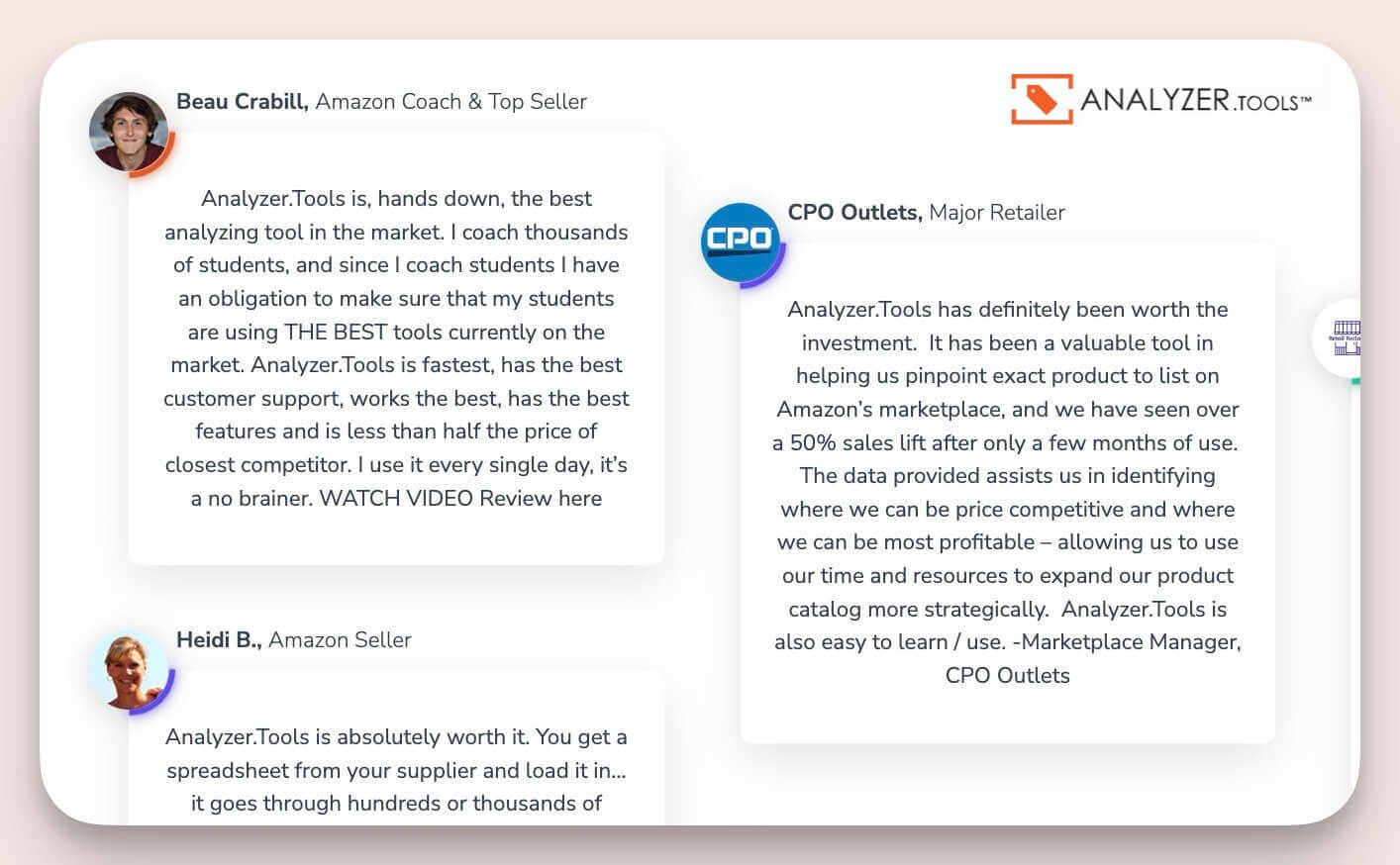
An Image Of Analyzer Tools With Testimonials A Better Alternative To Scan Unlimited
Scan Unlimited Alternatives: 5 Tools For Sellers Seeking More Features 3

Its filtering and sorting features enable sellers to handle both FBA and MFN calculations with remarkable precision. Beyond basic analytics, stage.analyzer.tools offers customizable dashboards, detailed profit calculators, and real‑time updates that empower users to manage thousands of listings.

Its dual compatibility with Windows and web‑based applications ensures seamless integration into diverse workflows, making it indispensable for high‑volume catalog evaluations.

2. Keepa

Keepa is a popular tool for Amazon sellers that provides real-time and historical data on product prices and sales ranks. Its browser extension integrates directly into Amazon, showing detailed price history charts and sales trends without needing to leave the product page. This makes it especially valuable for spotting pricing patterns and understanding a product’s past performance.

That said, Keepa has some downsides for power users. While it offers some bulk analysis features, they’re limited when working with large lists. It also doesn’t include built-in calculations for fees, ROI, or profit, so sellers have to check each item manually or use other tools to fill that gap. Because of this, Keepa is often used as a companion tool rather than a standalone solution for profitability analysis.

3. Price Checker 2

Price Checker 2 excels at providing up‑to‑the‑minute pricing updates and competitive market analysis. Its streamlined interface lets you effortlessly track price fluctuations, compare historical trends, and gauge competitor strategies at a glance.

This tool is especially valuable for sellers who need to optimize pricing decisions on the fly. With integrated trend visualizations and detailed competitor comparisons, Price Checker 2 offers a strategic advantage, ensuring that you can pivot quickly in response to market dynamics.

4. rocketsource.io

rocketsource.io offers robust market insights paired with efficient product research capabilities. Its advanced scanning engine uncovers both historical trends and current sales figures, delivering a comprehensive picture of market performance.

rocketsource.io is highly regarded for its clean interface and rapid data processing. It seamlessly integrates real‑time analytics with predictive insights, enabling sellers to identify emerging opportunities quickly. The platform’s deep dive into competitor metrics and market segmentation helps you optimize listings and stay ahead in competitive niches.

5. smartscout

smartscout leverages AI‑driven analytics to deliver highly accurate sales estimates, keyword insights, and trend forecasting. Its predictive approach allows sellers to pinpoint emerging market opportunities and optimize listings based on robust, data‑driven insights.

smartscout stands out for its user‑friendly design and powerful visualization tools. The platform’s advanced market prediction algorithms and comprehensive dashboard provide clarity and direction, making it a top choice for sellers who value innovation and precision in their product research strategies.

Comparing Accuracy and Pricing

Accuracy levels vary among these five platforms. stage.analyzer.tools excels in high‑volume data processing, while AT and Price Checker 2 offer rapid scanning with real‑time updates that keep you ahead of market trends. rocketsource.io delivers deep, actionable market insights, and smartscout’s advanced predictive analytics offer a strategic edge in competitive environments. Pricing is a key factor too—many sellers opt for demos or short‑term trials to determine which tool best aligns with their workflow and budget

Why stage.analyzer.tools Stands Out

If you’re serious about scaling your Amazon business, stage.analyzer.tools delivers a strong edge with a set of features tailored for high-volume, data-focused sellers. Here’s what makes it a standout choice:

  • Lightning-Fast Bulk Scans: Whether you’re analyzing a few hundred or tens of thousands of products, stage.analyzer.tools processes large lists with speed and accuracy. This is ideal for wholesale and online arbitrage sellers who depend on spreadsheet-based sourcing.
  • 58+ Data Points Per ASIN: Get detailed insights including FBA/FBM fees, ROI, net profit, sales rank, estimated monthly sales, buy box offers, and more—all in one scan. No need to jump between tools.
  • Built-In Profit Calculations: Unlike some tools that show raw data only, stage.analyzer.tools gives you instant visibility into profit margins, fees, and break-even points, so you can make decisions faster.
  • Real-Time Updates: Market data changes fast. stage.analyzer.tools stays synced with live Amazon data, helping you stay on top of price shifts, new competitors, and buy box changes.
  • Custom Filters & Views: Narrow down your product lists based on exactly what matters to you—whether it’s ROI thresholds, minimum monthly sales, or specific seller counts.
  • Export-Ready Results: Easily export filtered product lists for sourcing, repricing, or team collaboration. Clean formatting makes it simple to move from research to action.
  • Dual Compatibility: Use it via desktop or web—stage.analyzer.tools fits well into whatever workflow you’re running, whether you’re sourcing on the go or managing data at your desk.

If you’re looking for a tool that keeps up with the pace of modern Amazon selling and puts profitability front and center, stage.analyzer.tools is built for the job.

Bottom Line

Each alternative caters to different needs—from bulk product analysis to AI‑driven market predictions. If Scan Unlimited isn’t delivering all the features you require, these five tools provide robust options to enhance your Amazon selling strategy. By testing these platforms, you can find the one that best meets your needs—whether that means more precise profit tracking, unlimited scanning, or real‑time pricing updates.

In the surge toward 2025, Amazon sellers are seeking reliable data, streamlined workflows, and high‑impact features. The right tool can make all the difference in hitting your targets and staying competitive.

References

1. Scan Unlimited. (2025). “Amazon Seller Report 2025.” Available at: https://www.scanunlimited.com/resources/report-2025/

2. enjoy-aiia.com. (2025). “Scan Unlimited Alternatives.” Available at: https://enjoy-aiia.com/scan-unlimited-alternatives/

3. G2. (2025). “User Reviews for Amazon Selling Tools.” Available at: https://www.g2.com/

AMZScout vs. stage.analyzer.tools: Feature-by-Feature Breakdown

Looking to boost your Amazon business in 2025? Many sellers find themselves debating whether AMZScout vs Analyzer is the smarter pick for product research, sales data, and long-term growth. If you want further insights into how these tools compare in their functionalities, check out our comprehensive guide on Amazon product research for more details.

  • Understand how AMZScout and Analyzer align with your Amazon business needs and growth goals.
  • See how each tool’s product research, sales estimates, and analytical depth differ.
  • Compare user experiences, interface strengths, and learning curves for each platform.
  • Explore real-world outcomes, pricing, and how multi-tool strategies can sharpen your competitive edge.
  • Discover critical features like competitor monitoring, historical data trends, and advanced filtering.

1. Why These Two Platforms Are Worth Your Attention

AMZScout has grown to serve over 500,000 sellers, illustrating its growing success among both new and seasoned Amazon entrepreneurs [3]. Analyzer, meanwhile, has gained ground with sellers who crave precise market data and robust competitor insights. Comparing them is crucial if you want to pick the right tool for consistent results.

Most Amazon-focused software offers some mix of product research and cost calculation. However, AMZScout and Analyzer each have unique selling points that could tilt the scale in your favor. It’s about aligning their functionalities with what you need right now and projecting what will help your store over the next few years.

Additional Consideration: Restricted and Niche Product Research

When evaluating Amazon seller tools, it’s important to consider how well they help you navigate restricted brands and tricky product categories. Analyzer provides brand IP alerts to safeguard your account, while resources like this explainer on restricted brands can help sellers avoid costly mistakes. AMZScout covers a range of mainstream products, but if you deal in specialized or high-risk items, look for tools with built-in alerts and up-to-date catalog rules to stay ahead of compliance challenges.

2. Feature Highlights: Product Research and Sales Estimates

Both platforms focus on uncovering promising products in the vast Amazon catalog. According to a 2025 study, around 89% of new sellers now turn to third-party research tools to spot market gaps quickly [2]. AMZScout’s extensive product database exceeds 450 million listings, while Analyzer offers an AI-driven sales estimator said to be 95% accurate [6].

Accurate data is vital. An independent review by E-commerce Analytics Ltd. found AMZScout’s estimates to be 92% accurate, with Analyzer clocking in at 94% [5]. If you want to read more about effective product discovery approaches, try this resource on Amazon product research.

Beyond data accuracy, consider workflow. AMZScout’s Chrome extension is frequently praised for speed. Analyzer leans on heavy analytics for deeper trend predictions, which can be powerful if you like sifting through granular metrics.

Sales Tracking and Trend Analysis

AMZScout tracks sales trends with its AI technology, giving you weekly snapshots. Analyzer goes further by blending competitor monitoring with predicted future demand. Sellers who rely on advanced trend forecasting often prefer Analyzer’s specialized algorithms. In the long run, either tool can reduce guesswork.

Sellers who want to see how these tools affect real-world product selection might appreciate a brief look at how other Amazon sellers identify winning products. Check out how to find a product to sell on Amazon without guesswork for additional context.

If you’re interested in keeping business costs in check as you grow, consider reading about how tariffs are transforming Amazon FBA costs. This could influence which software you choose and how you approach sourcing overall.

3. User Experience and Learning Curve

Every minute saved means more time refining your product listings. In a 2024 usability study, AMZScout earned an 8.5 out of 10 for ease of use, while Analyzer rated 7.8 [4]. The difference stems mainly from interface design and tutorial depth. If you prefer a guided approach, AMZScout has a large collection of video tutorials. Analyzer offers in-depth webinars but has fewer tutorial videos.

Adjusting to Analyzer’s robust dashboards might take some practice. That said, many experienced sellers find Analyzer intuitive once they adapt to the interface. AMZScout is widely embraced by those who want immediate, surface-level insights without too many advanced steps.

4. Pricing and Long-Term Value

Cost matters, especially if you’re balancing a budget. AMZScout’s monthly plans start at $29.99 and go up to $59.99, while Analyzer ranges from $39.99 to $79.99 [9,10]. Some sellers prioritize the lower entry-level price, while others pay more for advanced functions. Both platforms occasionally offer lifetime deals, but these can be limited-time offers.

When assessing overall worth, factor in possible support costs, additional modules, and how swiftly the tool can help you make better sourcing decisions. If your primary interest is pitting multiple tools against each other in pursuit of the best ROI, see how Analyzer stacks up against other major solutions in this ROI-focused comparison.

5. Real-World Examples: AMZScout and Analyzer at Work

AMZScout’s site features a case study of a seller who vaulted from $3,000 to $25,000 in monthly revenue in just six months [5]. This growth was tied to using AMZScout’s product database to spot undervalued niches. Analyzer users highlight the tool’s competitor surveillance, citing strong results from pinpointing gaps in saturated categories.

One seller reported spotting a trending product through Analyzer’s trend predictor, moving $50,000 in sales within three months [7]. Both examples underscore how timely insights can kick-start sales. Keep in mind that these outcomes often require dedicated marketing efforts alongside the data these tools provide.

6. Additional Features Worth Noting

AMZScout recently integrated an AI Listing Builder that claims to improve product visibility by as much as 30% [1]. Analyzer counters with advanced competitor intelligence, allowing you to track up to 1,000 ASINs in real time. If your main target is building a brand and dominating your chosen niche, either feature set can be helpful.

New sellers sometimes stick to a single tool, but to ramp up quickly, mixing solutions can be smart. Another idea is layering your data sources by combining different software for a clearer look at market movements. If you want to see how multi-tool use can fill gaps, explore this piece on whether free tools can rival paid solutions.

For those considering budget-friendly tools when starting out, don’t miss this curated list of the best free tools for new Amazon sellers that might complement your main research software.

7. Common Questions About AMZScout and Analyzer

Is one better for beginners?

AMZScout often appeals to newer sellers due to its guided interface and extensive tutorials. Analyzer suits those who enjoy detailed analytics and have at least some experience scrutinizing metrics.

Which excels at keyword research?

Both offer keyword planners and reverse ASIN lookups. Sellers with a big emphasis on PPC strategies might lean toward AMZScout’s user-friendly interface, while data-driven users might prefer Analyzer’s comprehensive breakdown of volume, competitiveness, and historical shifts.

Does either tool include a Chrome extension?

They both do. AMZScout’s extension is especially known for quick scanning on Amazon’s product pages, which can save time. Analyzer’s extension offers a similarly useful snapshot view, though it has fewer user reviews.

Bottom Line

If you need a user-friendly path with plenty of tutorials and a large product database, AMZScout is a solid choice. Sellers who favor granular sales data and deeper analytics might opt for Analyzer. Your decision depends on budget, comfort level with data, and how you want to expand. If you’re still stuck on price, consider exploring which option delivers the best value for money before finalizing your pick.

Ultimately, both tools can save you significant research time, cut down on guesswork, and point your store in a profitable direction. Pair them with credible market research, consistent listing optimization, and plenty of testing—then watch your business move in a promising direction.

Looking to optimize your wholesale sourcing or bulk product validations at scale? stage.analyzer.tools is built for Amazon sellers who need reliability and speed in evaluating massive supplier lists, analyzing detailed Amazon marketplace data, and identifying high-opportunity products without the risk of outdated information. You can explore stage.analyzer.tools here to see how it transforms bulk research and accelerates your sourcing strategies.

FAQ

Is stage.analyzer.tools suitable for high-volume Amazon sellers handling wholesale?

Yes, stage.analyzer.tools was built for professional sellers who work with large or complex supplier catalogs. The platform processes up to a million products per hour and offers advanced features such as bulk spreadsheet scanning and custom profit calculations, making it a great fit for wholesale and high-volume FBA businesses.

How does stage.analyzer.tools help with restricted products and brand IP issues?

stage.analyzer.tools includes a dedicated Brand IP Alerts system. This features proactive notifications when you upload SKUs linked to known restricted brands or brands prone to IP claims. For more on this, see Amazon restricted brands guide.

Can I improve my sourcing by using stage.analyzer.tools alongside other free software?

Yes, many experienced sellers pair stage.analyzer.tools with additional free Amazon FBA tools to cross-check data or plug gaps in their workflow. Combining solutions can offer broader insights and sometimes better cost efficiency as your business grows.

What kind of trend or competitor analysis does stage.analyzer.tools provide?

The platform offers deep analytics on historical trends, projected sales, and allows you to pull data from top competitor storefronts or up to 100,000 Amazon catalog results using Deep Scan. This level of intelligence supports more informed decisions about which products, niches, and brands are worth further investment.

References

RevenueGeeks. (2025). AMZScout review. Retrieved from https://revenuegeeks.com/amzscout-review/

Jungle Scout. (2021). State of the Amazon seller report. Retrieved from https://www.junglescout.com/

AMZScout. (2023). AMZScout tutorials and user data. Retrieved from https://amzscout.net/

Seller Support Ratings. (2024). Customer support survey. Retrieved from https://www.sellersupportratings.com/

E-commerce Analytics Ltd. (2024). Amazon seller tool accuracy study. Retrieved from https://www.ecommerce-analytics.com/

Helium10. (2025). The growth of seller tools. Retrieved from https://www.helium10.com/

Analyzer. (2025). User case studies. Retrieved from https://www.stage.analyzer.tools/

Why Some Sellers Are Switching from Jungle Scout to Other Solutions (2025)

Looking for Jungle Scout alternatives that better fit your budget or toolset? You’re not alone—thousands of Amazon sellers, from first-timers to high-volume pros, are testing new software each year. If you’re unsure about switching, check out our competitor tool guide for real user insights.

Why Are Some Sellers Moving Away from Jungle Scout?

Jungle Scout is often recognized for its product research and sales estimates, but its pricing and limited marketplace coverage can lead many sellers to search elsewhere. Some find the data accuracy less reliable for certain categories, while others need more advanced capabilities for analyzing competition or managing pay-per-click (PPC) ads. Rising subscription costs also push budget-conscious sellers to look for cheaper or more specialized solutions.

Additionally, the Amazon ecosystem keeps changing. Sellers who need frequent updates, integrated international marketplaces, or deeper analytics may discover new platforms that align better with their goals. This evolution in seller needs naturally sparks interest in alternative tools.

Key Criteria for Choosing the Right Alternative

Accuracy is a top consideration. Many sellers emphasize reliable sales estimates and profit calculations to guide product launches correctly. Next, look at how well the tool fits your core priorities—is it primarily for product research, or do you also want PPC guidance and inventory monitoring?

Pricing matters too. Some tools charge a flat monthly fee, while others adopt pay-as-you-go models or offer free tiers for smaller sellers. If you’re still unsure which features matter most, consult our competitor tool comparison guide for deeper insights.

Finally, consider how frequently each solution adopts new features. Amazon’s policies and algorithms can shift overnight, so a proactive tool can help you stay competitive. Look for platforms that roll out updates regularly or incorporate emerging functionality such as AI-driven keyword research.

Exploring Additional Tools for Bulk Analysis

For power sellers handling vast product data, scaling your analysis capabilities is essential. Several platforms now cater specifically to bulk spreadsheet analysis and large-scale sourcing, offering deeper Amazon marketplace insight for professionals. If you’re looking to grow beyond entry-level research tools and want to compare options that allow for the scanning of massive catalogs, see these Scan Unlimited alternatives and feature-rich bulk analysis platforms. Leveraging such tools can make a significant difference in evaluating supplier offers efficiently and discovering untapped product opportunities.

1. stage.analyzer.tools

stage.analyzer.tools is a favorite for Amazon entrepreneurs seeking speed in bulk product evaluations. It calculates more than 50 vital metrics like fees, profit, and ROI for large product lists, making it extremely helpful for wholesalers and private-label sellers.

The platform offers a web-based version and a Windows desktop application. Both handle enormous datasets—up to one million products per hour—allowing you to assess options in record time. You’ll also find monthly and annual pricing tiers tailored to businesses of different sizes.

stage.analyzer.tools focuses on deeper data points such as inbound shipping costs, multi-pack logistics, and whether Amazon itself is on a listing. This depth helps you avoid potential pitfalls early on, especially if you’re juggling multiple SKUs across different niches.

2. Helium 10

Helium 10 has commanded attention by adding new features at a steady pace. According to a 2024 analysis, it saw a 25% jump in new users over the past year, with many praising its precise data. A recent comparison shows Helium 10’s sales estimates hitting roughly 93–95% accuracy, whereas Jungle Scout lands around 83–88% for the same products1.

One standout component is Adtomic, an AI-driven PPC tool that’s shown a 20% uptick in average ad performance for users switching from Jungle Scout1. Helium 10 also supports 21 Amazon marketplaces, helping FBA sellers expand globally. Pricing starts at $39/month, with advanced plans priced higher for those who need extensive data and automation.

This platform offers an array of tools—Black Box for product ideation, Cerebro for reverse ASIN lookups, and Magnet for keyword exploration. Some sellers do find it overwhelming at first because there’s so much to learn. Still, for data-hungry sellers or those with global reach, Helium 10 delivers robust coverage.

3. AMZScout

AMZScout has grown steadily, reporting a 40% year-over-year increase in its user base in 20242. Sellers highlight its budget-friendly plans and a Chrome extension that’s beginner-friendly. The free version offers limited checks, which can be handy if you want a trial run before upgrading.

Tools like Keyword Explorer and the FBA Calculator help you pinpoint winning products and gauge profitability quickly. AMZScout’s user interface feels simpler than Helium 10’s or Jungle Scout’s, and it appeals to entrepreneurs launching their first items. However, if you need advanced brand analytics or multi-country expansions, you may find AMZScout lacking compared to pricier platforms.

Users who switch to AMZScout often cite a sharper focus on cost. Its basic subscription offers features resembling more expensive tiers from competitors. Moreover, the service has garnered positive customer support ratings, which can be vital if you need fast help resolving issues.

4. Viral Launch

Viral Launch specializes in new product strategies and is well-regarded for reliable data across different niches. It claims over 98% accuracy on sales estimates in internal tests, making it a top pick for detail-focused sellers. Viral Launch’s Market Intelligence tool helps you forecast viability and plan your initial listing approach.

Additionally, the Kinetic PPC suite is robust for ad management. If your priority is beating the competition on launches, plug into Viral Launch’s advanced analytics for a deeper look at daily sales rank and competitor price changes. Its pricing typically starts around $69/month, and advanced plans include more automation—ideal if you have a larger operation.

A trade-off for newcomers might be the higher costs and the learning required to fully optimize the suite. Yet for skilled sellers, the insights and support from Viral Launch can accelerate market dominance. The platform’s somewhat smaller user community, though, means fewer peer-generated tutorials compared to major players like Helium 10.

5. ZonBase

ZonBase caters to both new and established sellers, featuring straightforward tools for product and keyword research. Its user base spiked by 30% in late 2024, thanks to generous usage limits on key functions compared to Jungle Scout’s starter plan3. This allows thorough exploration of multiple product ideas without worrying about daily or monthly caps.

In addition, ZonBase offers beginner-friendly options like ZonResearch for spotting hidden gems in less-competitive niches and ZonTracker for real-time keyword ranking checks. Focus is placed on personalized dashboards that help you keep your tasks organized.

The main criticism? ZonBase is lighter on brand-level analytics. If you aim to manage hundreds of SKUs or do advanced competitor mapping, you might outgrow it. However, for a balanced mix of usability and cost, ZonBase stands out as a strong Jungle Scout alternative.

Extra Considerations Before You Switch

Start by auditing your upcoming launches. If you’re selling in multiple countries, pick a platform that’s proven to handle global data. Also factor in how well each tool integrates with your existing workflow—do you need seamless PPC oversight, or is a simple listing analyzer enough?

Money often guides the final call. A tool offering more automation or advanced targeting could save hours of manual research each week. If you’re still weighing costs versus perks, check out which option provides the best value for money based on your monthly sales volume and expansion plans.

Finally, look at community support. Active Facebook groups or dedicated forums can make a big difference when you need real-world tips on using new features effectively. It’s not just about the tool’s capability; it’s also about how readily you can get answers.

Bottom Line

Whether you need advanced PPC automation, broader international coverage, or more accurate data, these five Jungle Scout alternatives cover a wide range of business needs. They can be budget-friendly or packed with top-tier analytics. For even more ways to refine your decision, explore our round-up of additional Jungle Scout alternatives and discover which solution elevates your Amazon strategy. For data-driven sellers interested in broader trends that impact sourcing and profits, it may help to stay up to date with current Amazon statistics and marketplace data as you compare these options.

As you decide, remember that every tool has a learning curve. Don’t shy away from free trials or short-term passes to compare results. Ultimately, the right pick is the one that syncs with your goals and pushes your Amazon business forward.

If speed, accuracy, and the ability to analyze massive wholesale catalogs are top priorities for your Amazon business, consider giving stage.analyzer.tools a closer look. You can upload price lists, assess supplier offers with up to 75 data points per product, and make more confident sourcing decisions. Whether you’re a bulk seller or expanding your inventory strategy, exploring stage.analyzer.tools could help you make the most out of every sourcing opportunity.

FAQ

Which Jungle Scout alternative is best for bulk product research?
stage.analyzer.tools is especially popular among high-volume Amazon sellers who need to analyze thousands—or even millions—of products at once. Its bulk scanning capability measures key data points including profit, ROI, and more, which is ideal for wholesalers and other professionals managing large catalogs.

Can I use these tools to research international Amazon marketplaces?
Yes, some alternatives such as Helium 10 support multiple international Amazon marketplaces, making it easier for sellers to expand globally. When exploring new markets, it’s smart to use a tool that provides market-specific data and frequent updates.

How do these platforms compare on price?
Most Jungle Scout alternatives offer a range of pricing plans. While AMZScout focuses on cost-effective options, others like Helium 10 and Viral Launch may charge more for extra features or automation. Look for a platform that aligns with your business size and budget, and take advantage of free trials where possible.

Do any of these tools help protect against restricted brands?
Yes. For example, stage.analyzer.tools includes Amazon restricted brands alerts, notifying users if a product is associated with brands that are known for intellectual property complaints. This can help sellers avoid potential listing violations and account risks. You can read more in their resource on Amazon restricted brands.

Are there tools that support bulk ASIN, UPC, or EAN conversion?
Yes, some platforms offer bulk ASIN-to-UPC/EAN conversion utilities, which simplify managing large product lists when sourcing from different suppliers. This is especially useful in wholesale operations. stage.analyzer.tools also provides educational resources about bulk conversion workflows.

References

Yaguara. (2025). 11 best Jungle Scout alternatives & competitors of 2025. https://www.yaguara.co/jungle-scout-alternatives/

TheSellingGuys. (2025). AMZScout review. https://www.thesellingguys.com/amzscout-review/

RevenueGeeks. (2025). Top 7 Jungle Scout alternatives in 2025. https://revenuegeeks.com/jungle-scout-alternatives/

5 Underrated Amazon Product Research Tools Besides Jungle Scout

Amazon product research tools are vital for sellers looking to uncover winning items and keep ahead of shifting trends. If you run a small e-commerce business or oversee a growing Amazon FBA operation, you know that tools like Jungle Scout dominate the conversation. However, there are lesser-known options that can match or outperform popular platforms.

According to a 2024 survey by eCommerceBytes, 34% of Amazon sellers now rely on AI-driven solutions—nearly a 50% jump since the prior year. For those seeking to explore different approaches, consider these insights on why Amazon product research matters before jumping into five hidden gems that may reshape your decision-making process.

Why Look Beyond Jungle Scout

Jungle Scout remains well-known for features like sales estimates, niche finders, and supplier tracking. Yet a study by SellerApp shows that 37% of Amazon sellers use multiple product research tools to get a clearer view of key metrics. Diverse data points can highlight new categories or budding trends that one tool alone might miss.

Moreover, many alternatives stand out for specialized features like real-time competition monitoring or multi-marketplace analysis. Some also offer simpler user experiences, especially for sellers who want a quick read on profitability. With so many evolving strategies in the Amazon selling space, branching out can be the edge you need.

Additionally, staying informed on the latest Amazon statistics can help you identify shifts in the marketplace and spot trends as they emerge. Leveraging up-to-date data ensures your sourcing strategy is built on real numbers rather than outdated assumptions.

1) SellerSprite

SellerSprite is recognized for its accurate estimates of product sales and traffic. It blends Amazon’s Best Sellers Rank (BSR) data with historical trends, which helps pinpoint how an item might perform over the long run. In one comparison study, 82% of tested products had sales estimates that fell within 5% of real volumes, a remarkable hit rate for analytics tools.

New sellers often prefer this platform for user-friendly dashboards. SellerSprite also excels at keyword tracking, so you can see which search terms best serve your listing. If you enjoy a straightforward interface and detailed keyword data, this tool might be worth adding to your roster. Compared to Zonbase or Scope, SellerSprite leans more on in-depth review of historical stats rather than broad competitor analysis.

2) Zonbase

Zonbase offers a suite that includes product research, listing optimization, and even PPC management. It uses a “ZonResearch” feature that draws attention to sales velocity and review patterns, assigning each product an “Opportunity Score” based on profitability and competition. Some sellers report a 23% boost in margins after switching to Zonbase, indicating its strong potential for driving bottom-line impacts.

What sets Zonbase apart is the way it factors in review velocity and listing quality to provide a more nuanced ranking system. Sellers also appreciate built-in tutorials for using its features efficiently. For a deeper look at other budget-friendly Amazon product research tools, you might find value in this overview of cost-effective solutions. Compared to SellerSprite, Zonbase covers a slightly broader range of tools in a single dashboard, although it may require a bit of time to master.

Exploring Amazon Competitor Research Tools

For sellers aiming to maximize their competitive edge, evaluating a range of Amazon competitor research tools is essential. Each solution brings a unique perspective, whether it’s uncovering market share, pinpointing profitable Amazon products, or tracking pricing shifts over time. These tools, including alternatives you may not have tried before, can reveal insights overlooked by mainstream solutions. Consider adding a robust competitor analysis tool to your workflow, or review a dedicated guide on choosing the right competitor tool for your Amazon business.

3) Sellics Benchmarker

Sellics itself is not exactly obscure, but its Benchmarker tool often goes unnoticed. Benchmarker draws from massive data sets to compare your current performance against similar sellers, letting you see whether your ad spend or organic rankings lag behind others in your niche. This perspective can be critical for zeroing in on missed revenue opportunities.

Many look to Sellics if they need advanced advertising insights alongside product research. According to Sellics, sellers using Benchmarker see an 18% improvement in advertising cost of sale (ACoS) after three months. While it covers less ground in traditional product research than SellerSprite, it excels at benchmarking how well your listings convert once you’ve found your niche.

4) Algopix

Algopix is a cross-marketplace platform that analyzes Amazon, Walmart, and eBay, making it useful for sellers interested in multi-channel strategies. Its reports show pricing averages, expected monthly units sold, and competition levels across different markets. This helps you decide whether a product will be more profitable on Amazon or another platform.

In real-world usage, some private label sellers have spotted lower-competition items on eBay before launching them on Amazon. Algopix’s advantage lies in identifying gaps among several marketplaces at once. By contrast, tools like Scope (featured below) focus primarily on Amazon metrics. If you anticipate growing beyond Amazon, Algopix can offer a broader scope of data.

5) Scope (by Sellics)

Scope is a lightweight Chrome extension that offers instant insights while browsing Amazon listings. You can see monthly sales estimates, keyword volumes, and pricing trends at a glance. This is a timesaver for busy sellers who don’t want to bounce between a full desktop app and Amazon.com.

Scope also integrates with the main Sellics platform, so you can switch from quick product browsing to deep-dive competitor analysis. Some users note that the sales estimates aren’t always as granular as Helium 10’s or Jungle Scout’s, but the speed and convenience compensate for that limitation. If you prefer scanning many potential products without pausing for complex data sets, this extension might be a worthy addition. For Chrome power users seeking new ways to streamline their workflow, check out a list of little-known free Chrome extensions for Amazon sellers.

Comparisons and Additional Considerations

All five tools can help you spot product opportunities, but each has its niche. SellerSprite and Algopix focus on historical patterns and multi-market analysis, respectively, making them strong for long-term or cross-platform sellers. Zonbase offers an all-in-one suite with an emphasis on PPC features, while Sellics Benchmarker is a standout for advertising and performance comparisons.

Scope is arguably the most convenient to use on the fly. Its Chrome extension offers quick checks that you can perform while doing everyday product browsing. Those planning to combine multiple data sets might benefit from more than one tool, especially if they plan a private label launch. According to a 2025 Feedvisor study, sellers who regularly use advanced product research tools reported a 2.7 percentage point boost in profit margins.

In making your decision, weigh factors like interface design, real-time data updates, pricing, and whether you want deeper competitor metrics or broad marketplace coverage. Testing free demos can be the fastest way to see if a given service meshes with your workflow.

Final Insights

Hidden gems exist in every corner of the Amazon product research world, and these five tools offer distinct solutions for businesses hoping to find profitable products. Whether you specialize in multi-channel selling, need sharper competitive benchmarks, or prefer a quick on-site scouting extension, there’s an option out there that can transform the way you do research.

If you’re ready to refine how you choose products, take the next step by exploring different data sources and strategies. You can also explore tips for pinpointing the perfect item in How to Find a Product to Sell on Amazon Without Guesswork. By examining multiple platforms, you’ll gain broader insights and open up new revenue channels in a highly competitive environment.

Looking to level up your wholesale sourcing or expand your Amazon product research toolkit? stage.analyzer.tools is designed for sellers who value accurate data, efficiency, and market analysis at scale. Discover how you can analyze supplier catalogs faster and uncover profitable opportunities that move your business forward.

FAQ

Which Amazon product research tool is best for bulk analysis?
While it depends on your workflow, sellers seeking to analyze thousands of SKUs at a time should look for tools with strong bulk processing capabilities. Platforms like stage.analyzer.tools are built for bulk Amazon product research and can help automate the scanning and evaluation of large supplier lists efficiently.
What’s the value in using multiple product research tools?
Diversifying your research stack gives you access to a broader range of data points and perspectives. As shown in the article, many sellers use several tools to cross-check metrics, track trends, and highlight unique opportunities in the market. This approach improves decision-making and reduces reliance on a single data source.
How do I decide between a browser extension and a full platform?
Browser extensions like Scope are ideal for quick, on-the-fly research directly within Amazon’s interface. Full platforms (such as Zonbase or SellerSprite) offer more robust dashboards with deeper analytics. The best choice depends on your daily workflow and whether you need detailed analysis or rapid listings checks.
Are there tools that help identify profitable products and protect against restricted brands?
Yes, some tools include brand restriction alerts that notify you of products with known intellectual property risks or selling restrictions. These features help safeguard your Amazon account by flagging brands with histories of complaints or limitations.

References

  1. eCommerceBytes. (2024). 2024 seller survey. https://www.ecommercebytes.com/example
  2. SellerApp. (2023). Multi-tool usage study. https://www.sellerapp.com/example
  3. Feedvisor. (2025). Amazon seller profitability analysis. https://www.feedvisor.com/example

Jungle Scout vs. Helium 10 vs. stage.analyzer.tools: Which One Delivers the Best ROI?

Jungle Scout vs Helium 10 vs stage.analyzer.tools is top of mind for many sellers eager to stay competitive on Amazon. In 2024, the demand for Amazon seller tools comparison has surged, with diverse software solutions helping newcomers and experts target profitable niches. For a deeper look at how ROI can be maximized through strategic product research, consider this Amazon product research overview.

Why Reliable Software Matters for Amazon Sellers in 2024

Third-party sellers now account for about 60% of total Amazon sales, up from around 25% in 2005 (1). As competition expands, tools that handle product research, keyword insights, and competitor data are essential for success. Sellers who rely on guesswork can miss current trends and accurate pricing opportunities.

Moreover, the rise of cross-border e-commerce has placed more emphasis on in-depth data. Chinese brands recently reached over 50% seller market share, pushing demand even higher for analytics-driven solutions.

Understanding Amazon Statistics and Tariff Impacts

Successful Amazon sellers are increasingly turning to detailed analytics and cost breakdowns to refine their product sourcing. Keeping track of evolving Amazon statistics can reveal shifts in marketplace dynamics and customer demand, while understanding the influence of tariffs is crucial for those importing goods. If you’re evaluating sourcing strategies, it may also help to review how tariffs are transforming Amazon FBA costs in 2024.

stage.analyzer.tools: A Data-Focused Choice

stage.analyzer.tools is appealing for its user-friendly design and emphasis on bulk product evaluations. It aims to save time by scanning large inventories to reveal net profit, Amazon fees, and potential ROI. Sellers also gain clarity on FBA or MFN cost structures, plus real-time updates through the tool’s direct Amazon API connections.

Unlike some rivals, stage.analyzer.tools offers a Windows desktop application and a web-based option. High-volume sellers appreciate the ability to process thousands (if not millions) of records in a single session. Pricing typically starts around $29 per month, placing it on par with entry-level competitors.

Because the platform provides up to 58 essential data points per product, it’s favored by users who want clear, numbers-driven dashboards. Its focus on margin calculation, inbound shipping costs, and multi-pack potential helps sellers break down every cost component. Current users regularly highlight how quickly they can dissect large wholesale lists to discover hidden gems.

Jungle Scout: Centered on Product Validation

Many Amazon entrepreneurs began with Jungle Scout because it pioneered accessible product research. Its interface spotlights sales estimates, competition metrics, and historical trends. Basic plans start around $29 per month, moving up to advanced tiers that deliver additional features like supplier databases.

Inventory Manager, a notable add-on, projects future stock needs, helping to prevent shortages. Although Jungle Scout’s estimates have a margin of error of 35 units, the tool remains a reliable gauge. In a 2022 assessment, Jungle Scout’s estimates stayed within 15% of actual sales for 82% of tested listings. That said, some advanced users may crave deeper functionality beyond product research and listing basics.

Jungle Scout also offers an extensive library of tutorials and a buyer-friendly refund policy. Beginners often appreciate the short learning path, but scaling sellers sometimes combine it with more feature-rich platforms for tasks like advanced PPC or multi-channel analytics.

Helium 10: A Wide-Ranging Suite

Helium 10 is known for its robust toolkit, including Black Box for product searches, Cerebro for reverse ASIN lookups, and Frankenstein for keyword processing. It maintains a strong reputation for data precision, with one study showing Helium 10 perfectly matched 38.2% of product sales estimates within a 22-unit margin.

While Helium 10’s monthly subscription can reach higher price points (over $80 for popular tiers), it delivers a broader selection of features for advanced sellers. The platform’s AI inputs, introduced in 2024, help refine product launches and create AI-enhanced images for listings. Experienced users who invest heavily in PPC optimization and listing automation report success using Helium 10’s advanced dashboards.

Still, the abundance of features leads to a steeper learning curve. Newcomers might need extra time to master tools like Cerebro, and the interface can feel too dense for individuals who only want quick product checks.

Accuracy and Data Reliability

When deciding between these three platforms, accuracy often comes up first. Sellers rely on believable estimates to measure market demand and set realistic sales targets. Jungle Scout typically cites an accuracy rate above 80%. Helium 10 stands out in reverse ASIN data but can slightly overestimate monthly volume for some product categories.

stage.analyzer.tools focuses on thorough trend tracking rather than guaranteeing the narrowest margin for monthly sales. Still, its emphasis on real-time updates from the Amazon API leads to relevant numbers, especially for sellers who frequently recheck stock status and price changes.

For big-budget decisions, many sellers cross-reference at least two tools. Major discrepancies rarely happen, but verifying data from multiple sources can provide extra peace of mind.

Pricing Tiers for Different Budgets

Jungle Scout, Helium 10, and stage.analyzer.tools each start around $29 per month for entry-level packages. Jungle Scout’s price climbs to $84 for pro tiers, Helium 10 hits around $209 per month for more advanced use, and stage.analyzer.tools tops out with its Enterprise plan.

When comparing top-level subscriptions, Helium 10 tends to have a steeper cost but bundles PPC, inventory management, listing optimization, and advanced marketing under one roof. stage.analyzer.tools keeps costs more modest by focusing on core data insight features. Jungle Scout sits in the middle, leaning heavily on product research but offering standard add-ons like the Supplier Database and Inventory Manager.

Sellers on a tight budget sometimes begin with the lowest monthly subscriptions or test free trial periods. Upgrading usually depends on business expansion, where expanded usage limits and automation matter more with higher sales volume.

Ease of Use

Beginners often praise Jungle Scout for straightforward navigation and a short learning curve. The tool’s interface highlights immediate must-know figures like estimated sales, average reviews, and competition level.

Helium 10 excels in depth but demands more training. Its built-in Freedom Ticket course helps, though users can expect a bigger time investment. stage.analyzer.tools stands out for clarity in data presentation, especially during bulk scanning sessions. Users who prefer immediate profit snapshots across extensive product lists tend to find it simpler compared to Helium 10’s advanced suite.

Many sellers decide based on how quickly they can get meaningful insights from each platform. Anyone venturing into brand-new categories may require advanced features, while mid-level sellers often value simplicity and quick scanning.

Unique Functionalities That Set Each Platform Apart

stage.analyzer.tools includes a Reverse Search feature that identifies recurring listings tied to specific customer search terms. That aspect can help confirm whether a product has genuine traction or if it’s a fleeting fad.

Jungle Scout boasts an Opportunity Finder, rating niches on a scale of one to ten. This appeals to newer sellers scouting gaps in the marketplace. Helium 10 has advanced listing tools like Scribbles and Frankenstein, enabling instant keyword expansions and thorough listing optimization.

These specialized features define how each tool tackles product research, targeting, and ongoing campaign improvements. For instance, Helium 10’s integrated PPC module grabs the attention of advanced sellers, while Jungle Scout’s simpler analytics keep the user experience approachable.

Which Tool Matches Your Seller Profile?

Small-scale or mid-level sellers often pick stage.analyzer.tools first for its moderate price and direct cost analysis. Its data-rich overview benefits anyone looking to validate wholesale lists or cross-check product feasibility in minutes. In contrast, new private-label entrepreneurs may lean on Jungle Scout for assistance in finding that very first product to launch.

For large businesses expanding across multiple international marketplaces, Helium 10’s wide coverage becomes more appealing. It supports over 20 Amazon regions and offers a deeper approach to PPC strategy, including AI-based suggestions to refine ad campaigns.

Ultimately, sellers can mix and match. Some do initial research in Jungle Scout, then refine their ad spend in Helium 10, while using stage.analyzer.tools to finalize cost breakdowns. Each platform plays a unique role depending on whether you’re just starting, scaling, or diversifying into multiple categories.

Final Insights

The world of Amazon FBA software in 2024 continues to expand, and each platform serves a specific audience. Jungle Scout delivers an accessible research environment, Helium 10 caters to power users craving advanced functions, and stage.analyzer.tools keeps a heavy focus on bulk data accuracy for cost-focused sellers.

As competition grows and more Chinese brands join the platform, having accurate market data matters more than ever. If you want additional guidance on product research strategies, you might find this Amazon product research overview useful.

Whichever path you pick, it pays to revisit tool metrics regularly and adapt your strategy as trends shift. If you’re ready to explore a balanced solution that merges speed with thorough data coverage, you can also look into the stage.analyzer.tools Web App for a quick test drive.

Curious how stage.analyzer.tools can help simplify your wholesale sourcing and maximize your product insights? Take a closer look at stage.analyzer.tools and see how a professional-grade analytics tool can save you time while revealing hidden opportunities in bulk Amazon price lists.

FAQ

Which Amazon seller tool is best for bulk wholesale analysis?
stage.analyzer.tools is specifically designed for professional Amazon sellers handling large-scale supplier price lists. Its ability to scan thousands or millions of SKUs per hour, combined with up to 75 data points per product, makes it a top choice for any seller needing fast bulk analysis.

How do features differ between Jungle Scout, Helium 10, and stage.analyzer.tools?
Jungle Scout prioritizes beginner-friendly research and niche validation, Helium 10 offers a wide suite including PPC and listing optimization for advanced users, while stage.analyzer.tools zeroes in on advanced Amazon product research features and in-depth cost breakdowns, particularly suited for wholesale and bulk analysis.

What should sellers consider when choosing an Amazon seller tool?
Consider your business stage, monthly budget, and which features matter most to your operations—such as reverse sourcing, competitor research, or bulk price list scanning. Sellers scaling up benefit from tools like stage.analyzer.tools, while those focused on private label launches might start with something like Jungle Scout.

Can stage.analyzer.tools help with restricted brands and intellectual property concerns?
Yes. stage.analyzer.tools includes a brand IP alerts system that flags items associated with restricted brands or brands with known IP complaint histories, helping protect your account from potential listing issues.

Are there resources to help sellers get more from these platforms?
Many Amazon seller tools offer video libraries, knowledge bases, or support chat for onboarding and troubleshooting. stage.analyzer.tools users can also review practical resources such as the bulk convert ASIN to UPC/EAN/ISBN knowledge base, which helps streamline catalog management.

References

Sellersprite. (2024). Amazon 2024 annual report. https://www.sellersprite.com/en/blog/amazon-2024-annual-report

Sellercandy. (2024). 2024 guide to best Amazon seller tools. https://blog.sellercandy.com/2024-guide-to-best-amazon-seller-tools

MyAmazonGuy. (2024). Amazon seller tools H10 vs Jungle Scout. https://myamazonguy.com/amazon-seller-tools-h10-vs-jungle-scout/

Top Jungle Scout Alternatives for Advanced Amazon Product Research

Looking for powerful Jungle Scout alternatives in 2025? Many advanced Amazon sellers want tools that offer sharper data accuracy, broader market insights, and smart features that push their business forward. If you’d like additional tips to spot the most robust options, take a look at our guide on advanced Amazon product research.

  • Discover top-rated Jungle Scout alternatives for high-volume Amazon sellers
  • See how tools differ on pricing, data accuracy, and market insights
  • Get practical advice on evaluating bulk analysis features and competitor tracking
  • Explore links to advanced profit calculators and FBA cost-saving resources

Common Features to Focus On

Advanced sellers often juggle multiple challenges: product sourcing, PPC tactics, and pricing decisions all at once. According to a 2025 survey of nearly 1,500 sellers, 38% say higher shipping and manufacturing costs are among their top obstacles [1]. Features like accurate profit calculators, real-time inventory tracking, and competitor insights can be indispensable tools for overcoming these hurdles.

Data accuracy is also vital. Research shows that top-rated software today hovers around 95% accuracy in sales estimates, up from about 85% in earlier years [1]. As you compare different solutions, consider whether each tool’s estimates, keyword data, and historical trends give you a clear edge.

Scaling Product Research for Amazon Sellers

The Amazon marketplace in 2025 is more competitive than ever, which means sellers need tools that can handle bulk data, perform deep analytics, and offer reliable profit and cost modeling. Whether you’re verifying potential FBA profitability or filtering for the best wholesale products, using the right research software can add real efficiency to your workflow. Platforms offering integrated calculators, brand restriction alerts, or advanced bulk conversion (like ASIN-to-UPC converters) are quickly becoming essential for scaling operations and staying compliant.

7 Best Jungle Scout Alternatives for 2025

1. stage.analyzer.tools

stage.analyzer.tools ranks high for advanced Amazon sellers who need speed and reliability in bulk product analysis. It processes large lists quickly, providing up to 58 critical data points like fees, ROI, and profit margins. It also offers filtering and sorting for sellers who want to handle FBA or MFN calculations with precision.

Compared to Helium 10, stage.analyzer.tools emphasizes bulk actions and profit analytics. Many sellers note that its Windows and web-based applications streamline day-to-day tasks, especially for those who manage thousands of listings. If you’re aiming to systematically evaluate high-volume catalogs, this option stands out. For further information on tools for new sellers, check out this Amazon seller toolkit.

2. Helium 10

Helium 10 is known for advanced keyword analytics, product research, and a built-in PPC management platform. Its AI-driven ad optimization has helped boost user adoption by 25% over the past year, with accuracy levels for sales estimates reaching 94% [2]. This is just a hair above Jungle Scout’s reported 93%, according to multiple field tests.

In contrast to stage.analyzer.tools, Helium 10 offers an extensive set of listing enhancement features. Those who prefer a single ecosystem often lean on Helium 10’s multi-tool dashboard. It does, however, come with a slightly higher learning curve than some smaller platforms.

3. AMZScout

AMZScout gained traction for user-friendly dashboards and a strong product database. In 2025, it recorded a 30% user growth among sellers who favor long-term data tracking [2]. Its G2 rating of 4.8/5 is notably higher than Jungle Scout’s 4.1/5, a fact that often draws in new sellers.

Compared to ZonGuru or Sellics, AMZScout stands out for its simple interface and a flexible pricing model. AMZScout does lack certain advanced PPC functions that Helium 10 excels at, but its strengths in niche research are well-known among mid-level and advanced sellers.

4. Viral Launch

Viral Launch places emphasis on market intelligence data and predictive analytics. Some sellers claim it rivals Helium 10 in forecasting future product trends, which is crucial in rapidly shifting categories like electronics. Sales estimates tend to be accurate, and its “Kinetic” PPC tool helps automate ad campaigns.

Compared to AMZScout, Viral Launch digs deeper into competitor analysis by showing broader seasonal trends. However, Helium 10 surpasses it with more comprehensive keyword insights. Sellers who want to zero in on high-precision data still give Viral Launch a strong recommendation, especially for brand-building strategies.

5. Sellics

Sellics offers a suite that includes advertising optimization, profit tracking, and competitor monitoring. Users say its advertising module makes it a solid alternative to both Jungle Scout and Helium 10. If your priorities include an all-in-one platform for profit analytics, Sellics frequently appears on shortlists. Learn more about Amazon’s FBA fees and how they impact profit with the FBA fee and profit calculator.

In contrast to stage.analyzer.tools, Sellics often focuses on automated bidding for ads rather than bulky product data processing. For those seeking a direct comparison of each tool’s ROI, see this evaluation of Jungle Scout, Helium 10, and stage.analyzer.tools. Sellics can be more expensive at the top tiers, so keep pricing in mind if you manage a tight budget.

6. ZonGuru

ZonGuru has positioned itself as a cost-friendly platform with interesting perks like “Easy Source,” which streamlines supplier research. Its basic plan starts at $29/month—around half of Jungle Scout’s $49/month entry-level. Though it may not match Helium 10 for PPC automation, it does provide valuable review insights that can guide listing improvements.

When contrasted with AMZScout, ZonGuru offers robust product research and simpler listing optimization features. Sellers who want curated data around competitor reviews find ZonGuru especially appealing. This tool can also fit well for those stepping beyond a beginner tool but not quite ready for a hefty monthly invoice.

7. Keepa

Least similar to Jungle Scout, Keepa is widely celebrated for its historical pricing data and advanced product tracking. Priced at about $17.50/month, it’s cheaper than Jungle Scout’s entry-level, making it tempting for experienced sellers who want thorough price history graphs. Keepa focuses less on listing optimization but excels at charting marketplace shifts.

Compared to Sellics or Viral Launch, Keepa has a narrower feature set. Many advanced sellers pair Keepa with a tool like stage.analyzer.tools for deeper profit calculations. If you prioritize real-time alerts on price changes and stock availability, Keepa can be a strong supporting platform. You can explore other lesser-known product research options in our article on underrated Amazon product research tools.

Comparing Accuracy and Pricing

Accuracy levels vary slightly among these seven, with Helium 10 often cited as having an edge in keyword statistics. Meanwhile, stage.analyzer.tools stands out for high-volume data processing, a feature that’s crucial for sellers who handle hundreds of potential products each week. Pricing also matters, especially as monthly tool expenses can stack up quickly.

Some platforms, like ZonGuru, attract those who watch every dollar, while Helium 10 offers more elaborate features for a higher fee. Many sellers proceed with trials or short-term passes. That approach helps them see which platform’s estimates and analytics align best with their business goals.

Bottom Line

Each alternative caters to different needs: from bulk product analysis to AI-driven PPC. For those scaling quickly, an option like stage.analyzer.tools or Helium 10 might fit best. If you’d like additional perspective on why sellers leave Jungle Scout behind, you can check out why some sellers switch to other solutions.

In the surge toward 2025, Amazon sellers want reliable data, straightforward workflows, and high-impact features. By testing different services, you’ll discover the one that helps you reach real-world targets, whether that means a higher profit margin or easier management of thousands of listings.

Interested in optimizing your wholesale sourcing or scaling your Amazon FBA research with powerful bulk analysis tools? Try stage.analyzer.tools for fast supplier list scanning, extensive marketplace insights, and features designed for high-volume Amazon sellers. Start exploring your next-level product research strategy today.

FAQ

What makes stage.analyzer.tools a strong Jungle Scout alternative?

stage.analyzer.tools is uniquely focused on bulk product research and high-speed supplier list scanning, letting users instantly see which items are profitable and in demand. Its in-depth analytics and multiple filtering options serve sellers who need data on thousands of products at once, making it well suited for those working at scale.

How do these Amazon seller tools differ in data accuracy?

While most tools advertise high accuracy, stage.analyzer.tools and Helium 10 are often recognized for precise sales estimate data, especially in high-volume and competitive categories. This can be essential when gauging real product demand and avoiding overstocking.

Can these tools help me stay compliant with Amazon brand restrictions?

Yes, several platforms—including stage.analyzer.tools—can alert you to restricted brands and IP risk issues before you source or list products. For more about navigating Amazon brand guidelines, visit our article on Amazon restricted brands.

Which tool fits best for sellers on a budget?

ZonGuru and Keepa tend to offer budget-friendly plans, while more advanced platforms like stage.analyzer.tools provide a strong value for larger catalogs. The right choice often comes down to the volume you handle and must-have features.

How do I decide between different FBA calculators and profit tools?

It often depends on how many products you need to analyze and whether you want detailed costs broken out. For example, stage.analyzer.tools gives a full breakdown with up to 75 data points, while others might only scratch the surface. Try different options and see which workflow fits your business style.

References

Jungle Scout. (2025). Amazon seller report 2025. Retrieved from https://www.junglescout.com/resources/reports/amazon-seller-report-2025/

Enjoy-aiia.com. (2025). Jungle scout alternatives. Retrieved from https://enjoy-aiia.com/jungle-scout-alternatives/

G2. (2025). AMZScout user reviews. Retrieved from https://www.g2.com/products/amzscout/reviews

How to Sell Wholesale Products on Amazon in 2025 (Full Guide)

Are you looking to start or scale an eCommerce business? Selling wholesale products on Amazon using Fulfillment by Amazon (FBA) presents an excellent opportunity for those seeking a reliable and scalable income stream. Whether you’re searching for a side hustle or looking to build a full-fledged business, leveraging Amazon’s infrastructure can help you succeed with minimal logistical hassle.

  • Amazon Wholesale FBA lets you sell branded products without building your own label.
  • Data-driven tools streamline bulk product research and sourcing for efficiency.
  • Profitability depends on picking in-demand, low-competition products and reliable wholesale suppliers.
  • Successful sellers analyze competition, avoid restricted brands, and use bulk analysis software.
  • Platform features like brand IP alerts, sales history, and detailed product metrics help minimize risk.

Selling wholesale on Amazon can be a scalable and profitable business model, especially when combined with the right tools to streamline sourcing, pricing, and inventory management. 15 Best Amazon Seller Tools for FBA in 2025 can help you maximize efficiency and profitability.

This guide will cover selling strategies, the advantages of Amazon Wholesale FBA, comparisons with other business models, and tips to help you source profitable wholesale products effectively.

What is Amazon Wholesale FBA?

Amazon Wholesale FBA involves purchasing branded products in bulk from distributors, suppliers, or manufacturers and reselling them as individual units at a profit. Unlike private labeling, wholesale selling eliminates the need to develop your own brand, making it a faster and less risky way to scale an Amazon business.

The Fulfillment by Amazon (FBA) model takes care of storage, packaging, and shipping, allowing sellers to focus on sourcing and scaling operations. Traditional wholesale businesses require renting warehouses and hiring staff to handle logistics, but Amazon FBA reduces upfront costs and operational headaches by shifting fulfillment responsibilities to Amazon.

Wholesale vs. Other Business Models

To make an informed decision, it’s essential to compare Amazon wholesale with other common selling strategies.

Wholesale vs. Retail Arbitrage

Retail arbitrage involves buying discounted products from retail stores and reselling them on Amazon at a higher price. While this method has a low barrier to entry, it requires continuous effort to source inventory manually.

Pros:

  • Low startup costs
  • Ideal for beginners
  • No minimum order quantities

Cons:

  • Time-consuming and hard to scale
  • Requires constant product hunting
  • High competition and risk of price fluctuations

Wholesale vs. Online Arbitrage

Online arbitrage follows the same concept as retail arbitrage but sources products from online retailers instead of physical stores.

Pros:

  • Work-from-home flexibility
  • Access to thousands of online stores

Cons:

  • Intense competition due to widely available deals
  • Difficulty in restocking the same profitable products

Related: 15 Best Amazon Seller Tools for FBA in 2025

Wholesale vs. Private Label

Private label selling involves creating your own brand by sourcing generic products from manufacturers and adding unique branding and packaging.

Pros:

  • Full control over branding and pricing
  • No competition on your listing
  • Potential for long-term brand growth

Cons:

  • High startup costs ($10k+ recommended)
  • Requires marketing investment
  • No guaranteed demand

Wholesale vs. Dropshipping

Dropshipping allows sellers to sell products without holding inventory, where suppliers ship items directly to customers.

Pros:

  • No inventory storage or handling required
  • Minimal upfront costs

Cons:

  • High risk of account suspension (violates Amazon’s policies if not done correctly)
  • No control over fulfillment speed and product quality
  • Limited profit margins

Selling Wholesale on Amazon

The wholesale business model combines the scalability of private label with the low risk of arbitrage. Instead of constantly hunting for deals, you can reorder profitable products in bulk, ensuring a stable and scalable income stream.

With wholesale selling, you can analyze past performance data to minimize risks. Using tools like stage.analyzer.tools, sellers can quickly assess sales trends, pricing history, competition, and profit margins before making a purchasing decision.

How stage.analyzer.tools Supports Large-Scale Amazon Wholesale Operations

Managing wholesale catalogs with thousands of SKUs can overwhelm even experienced Amazon sellers. stage.analyzer.tools stands out by scanning price lists in bulk and delivering instant profit calculations, sales history, competitive analysis, and even alternative feature comparisons with other tools. Features like deep scans, bulk data import, and customizable filters offer the flexibility and control needed for professional sourcing at scale. This is especially valuable for avoiding restricted brands on Amazon or quickly building a shortlist of the most profitable products. If you regularly deal with large supplier price sheets, stage.analyzer.tools dramatically cuts research time and improves your sourcing accuracy.

Steps to Start Selling Wholesale on Amazon

  1. Create an Amazon Seller account
  2. Find profitable wholesale products using data-driven sourcing tools
  3. Contact suppliers and open wholesale accounts
  4. Order and ship inventory to Amazon’s FBA warehouse
  5. Let Amazon handle fulfillment while you collect profits!

Best Wholesale Products to Sell on Amazon

Choosing the right products is critical to success. The goal is to find products with high demand and low competition. Instead of guessing, use bulk analysis software to filter through supplier catalogs and identify hidden gems quickly.

What to Look for in a Profitable Wholesale Product:

  • Consistent sales history – Avoid seasonal products unless planned strategically.
  • Lightweight and small – Lower shipping costs increase profitability.
  • No Amazon competition – Avoid listings where Amazon is a seller, as they dominate the BuyBox. For more information on identifying when Amazon is competing, see Amazon Restricted Brands: What You Can and Can’t Sell.
  • Healthy profit margins – Ensure profitable after all fees. To help with this, check out our Amazon FBA Fee and Profit Calculator to quickly run the numbers before you make an order.

Tips for Selling Wholesale on Amazon

  • Check if Amazon is a competing seller – Amazon prioritizes its own inventory in the BuyBox. Avoid products where Amazon holds significant stock.
  • Use competitive pricing strategies – Instead of undercutting competitors, price competitively while maintaining healthy margins.
  • Stick to smaller, lightweight products – This reduces FBA storage fees and shipping costs, maximizing profit margins.
  • Factor in all Amazon fees – Use a profit calculator like stage.analyzer.tools to ensure profitability before purchasing.
  • Avoid “Amazon supplier directories” – The best suppliers are not publicly listed; find them through trade shows, industry contacts, or direct outreach.
  • Follow Amazon’s Terms of Service – Failure to comply can result in account suspension. For more on staying compliant as a new seller, review the best free Amazon seller tools available.

Finding Wholesale Suppliers

1. Use Wholesale Trade Shows

Industry trade shows like ASD MarketWeek feature top suppliers. Even if you can’t attend in person, exhibitor lists can be valuable for supplier outreach.

2. Source by Competing Seller Storefronts

Use stage.analyzer.tools’ Storefront Search to analyze competitors’ inventory and identify brands they source from. Then, contact these brands to open wholesale accounts.

3. Reverse Sourcing on Amazon

Instead of searching for suppliers first, identify low-competition profitable products on Amazon, then trace them back to the manufacturers.

4. Subscribe to Trade Publications

Industry magazines and wholesale directories provide insight into upcoming trends and supplier contacts. You can supplement this with powerful Amazon product research tools to spot opportunities faster.

Final Thoughts

Selling wholesale products on Amazon via FBA is a scalable, low-risk business model that offers long-term growth opportunities. Unlike arbitrage, it allows repeatable product sourcing, and compared to private label, it involves less upfront investment and risk.

To succeed, data-driven decision-making is key. Use powerful analytics tools like stage.analyzer.tools to quickly assess wholesale catalogs and make profitable sourcing decisions. By leveraging Amazon FBA’s logistics, focusing on high-demand, low-competition products, and working with reliable suppliers, you can build a profitable and sustainable business on the world’s largest eCommerce platform.

Ready to level up your Amazon wholesale business? Try stage.analyzer.tools for a smarter, faster approach to bulk product research and supplier catalog analysis. Its data-rich platform is purpose-built to help Amazon sellers find the right products faster and minimize risk—so you can focus on growth, not guesswork.

FAQ

How do I know if a wholesale product is allowed or restricted on Amazon?
Before purchasing inventory, always check for Amazon restricted brands and categories. stage.analyzer.tools has integrated alerts for known restricted brands to help you avoid compliance issues and protect your seller account.

What are the main benefits of using stage.analyzer.tools for wholesale Amazon sourcing?
stage.analyzer.tools is designed for high-volume sellers who want to quickly scan, analyze, and filter large supplier lists for the best opportunities. Its bulk spreadsheet scan, historical price charts, and brand IP alerts save time and help you confidently choose profitable products.

How does wholesale compare to retail and online arbitrage?
Wholesale is more scalable and less labor-intensive over time, since you can reorder from distributors rather than constantly search for deals. With the right FBA software and proper sourcing strategy, wholesale offers a stable, repeatable income stream and fewer logistical headaches than retail arbitrage.

Can stage.analyzer.tools help with bulk converting product codes like ASIN to UPC or EAN?
Yes, stage.analyzer.tools integrates seamlessly with bulk data workflows and works alongside utilities such as ASIN to UPC/EAN converter tools when you need to match supplier lists to Amazon catalog data efficiently.

15 Best Amazon Seller Tools for FBA in 2025

Amazon sellers operate in an increasingly competitive market. To get ahead, leveraging powerful seller tools isn’t optional—it’s essential. This guide details the 15 best Amazon seller tools, their benefits, pros and cons, comparisons, and essential insights. Additionally, you’ll learn how to choose the right tool for your business no matter what stage you’re at.

How to Choose the Best Amazon Seller Tool

  • Identify specific needs: Wholesale, arbitrage, advertising, or private labeling.
  • Consider business scale: Tools should accommodate business growth.
  • Budget wisely: Balance cost against functionality.
  • Ease of Use: Match tool complexity with your experience.
  • Support quality: Tools should offer robust support and resources.

Comparison: Top Amazon Seller Tools

ToolPrimary UsePricingEase of UseAnalytics DepthBest For
Analyzer ToolsWholesale AnalyticsAffordableEasyHighBulk Wholesale Sellers
KeepaPrice TrackingAffordableModerateHighHistorical Price Checks
Viral LaunchMarket IntelligencePremiumModerateHighProduct Launches
SellerAmp SASArbitrage AnalysisModerateEasyModerateRetail Arbitrage
Inventory LabInventory ManagementModerateEasyHighLarge Inventories
Jungle ScoutProduct ResearchPremiumEasyHighProduct Research
SellerAppPPC ManagementPremiumModerateHighAdvertising & Analytics
Helium 10Comprehensive SuitePremiumModerateHighComprehensive Analytics
Seller SnapAutomated RepricingPremiumEasyHighCompetitive Niches
SmartScoutCategory ResearchPremiumEasyHighMarket Research
FeedbackWhizFeedback ManagementModerateEasyModerateReputation Management
PerpetuaAdvertising ManagementPremiumModerateHighAd Campaign Optimization
AMZScoutCompetitor AnalysisAffordableEasyModerateBeginners
TeikametricsAdvertising AnalyticsPremiumModerateHighROI-focused Advertising
PixelfyURL ManagementAffordableEasyModerateMarketing & Tracking

1. Analyzer Tools

stage.analyzer.tools is a leading wholesale analytics platform designed specifically for bulk product analysis and intelligent sourcing.

15 Best Amazon Seller Tools For 2023

With unmatched speed (up to 1,000,000 products per hour), stage.analyzer.tools provides sellers with rapid insights, detailed historical sales data, and real-time IP alerts. Its intuitive and customizable grid view makes navigating large datasets seamless, significantly reducing time and effort during product selection.

  • Benefits: Increased profitability, significant time savings, superior competitive insights.
  • Pros: Fast and efficient processing, comprehensive analytics, affordable pricing structure.

Read more: Amazon Product Research: What It Is and Why It Matters

2. Keepa

Keepa excels at providing historical pricing and sales data crucial for making informed sourcing decisions. Sellers rely on Keepa’s easy-to-read graphs that clearly visualize market trends and pricing fluctuations over time, aiding strategic pricing and inventory management decisions.

  • Benefits: Reliable historical trend analysis, reduced risk in sourcing decisions.
  • Pros: Extensive and detailed historical data, straightforward visualization.
  • Cons: Potentially overwhelming interface for beginners.

For additional support when reviewing price history and brand restrictions, you can also refer to our guide on Amazon restricted brands.

3. Viral Launch

Viral Launch provides powerful tools for product discovery, market analysis, and listing optimization. Known for its accurate keyword recommendations and market intelligence, Viral Launch helps products gain maximum visibility and competitiveness from the start.

  • Benefits: Effective product launches, improved market penetration.
  • Pros: Strong analytics, effective keyword and optimization tools.
  • Cons: Higher cost may not suit smaller budgets.

If you’re a new seller, you may also benefit from our curated list of the best free tools for new Amazon sellers to jumpstart your journey on Amazon.

4. SellerAmp SAS

SellerAmp SAS is an invaluable tool for retail and online arbitrage sellers, offering immediate insights into profitability directly within browser windows or through its mobile app. SellerAmp’s quick, at-a-glance data helps sellers make confident, timely sourcing decisions.

  • Benefits: Real-time profitability, efficient sourcing decisions.
  • Pros: Mobile-friendly, user-friendly interface.
  • Cons: Limited capability for bulk analysis.

Managing product identifiers for arbitrage? Try our free ASIN to UPC/EAN converter for fast lookup and conversion needs.

5. Inventory Lab

Inventory Lab significantly streamlines the complexities of inventory management, financial tracking, and product listings, making it ideal for sellers managing large product catalogs. Its efficient barcode scanning integration accelerates the listing and inventory process.

  • Benefits: Accurate inventory management, streamlined financial tracking.
  • Pros: Easy integration, comprehensive reporting.
  • Cons: Less practical for small inventories.

6. Jungle Scout

Jungle Scout is highly recognized for robust product research and supplier verification. Sellers utilize its extensive database for reliable product trend forecasts, identifying profitable niches, and gaining supplier trustworthiness.

  • Benefits: Effective niche discovery, supplier reliability.
  • Pros: User-friendly, powerful analytics.
  • Cons: Relatively expensive subscription.

Discover more: Top Jungle Scout Alternatives

7. SellerApp

SellerApp integrates deep analytics with PPC campaign management, helping sellers optimize advertising spending and gain actionable market insights. It focuses on enhancing profitability through strategic marketing and optimization.

  • Benefits: Maximized advertising ROI, targeted market analytics.
  • Pros: Strong PPC functionality, detailed performance metrics.
  • Cons: Requires dedicated learning.

8. Helium 10

Helium 10 offers a broad suite of powerful tools for keyword research, product optimization, and profitability tracking. Its comprehensive toolset makes it versatile enough for all types of Amazon sellers, from beginners to established brands.

  • Benefits: Diverse solutions, broad applicability.
  • Pros: Comprehensive suite, scalability.
  • Cons: Complexity for newcomers.

For additional strategies on powering up your keyword research, refer to our article on free keyword tools for Amazon listings.

9. Seller Snap

Seller Snap offers AI-driven pricing optimization, automating price adjustments to maintain competitiveness without sacrificing profit margins. It’s highly effective for sellers in competitive niches requiring real-time repricing.

  • Benefits: Improved profitability, reduced manual effort.
  • Pros: Exceptional AI-driven automation.
  • Cons: Premium pricing.

10. SmartScout

SmartScout provides a powerful way to explore Amazon’s marketplace through brand, seller, and product intelligence. Its visual “seller map” and category explorer reveal how brands compete, what products drive traffic, and where new opportunities exist. It’s especially useful for wholesale and agency sellers looking to analyze competitors and uncover hidden product gaps.

  • Benefits: Unique insights into market share, brand reach, and cross-seller relationships.
  • Pros: Unique seller and brand mapping, high data accuracy, and intuitive navigation.
  • Cons: Wholesale plan has limited scan volume; some advanced analytics require higher-tier subscriptions.

11. FeedbackWhiz

FeedbackWhiz streamlines customer feedback management, automating the collection of reviews to improve brand reputation and foster customer loyalty. It simplifies feedback monitoring and timely responses.

  • Benefits: Stronger brand trust, efficient feedback management.
  • Pros: Automated review generation and response tools.
  • Cons: Specialized solely in feedback management.

12. Perpetua

Perpetua effectively manages Amazon advertising through AI-driven analytics, optimizing ad campaigns for maximum return on investment. Ideal for sellers looking to improve campaign effectiveness significantly.

  • Benefits: Optimized ad performance, higher profitability.
  • Pros: Excellent ad management, powerful analytics.
  • Cons: May require learning for maximum benefit.

13. AMZScout

AMZScout offers accessible, intuitive tools for product research and competitor analysis. Its simplicity makes it an excellent starting point for new sellers or smaller-scale Amazon businesses.

  • Benefits: Accessible market research, intuitive use.
  • Pros: Beginner-friendly design.
  • Cons: Limited advanced options.

Explore further: AMZScout vs. stage.analyzer.tools

Doing Bulk Amazon Product Research Faster

Speed is essential for wholesale and arbitrage sellers dealing with extensive supplier catalogs. Not every software is purpose-built for quick, accurate Amazon bulk analysis. Advanced tools like stage.analyzer.tools allow you to upload, scan, and filter massive product lists at scale, helping you uncover profitable items faster than manual checks or lighter browser extensions. If you’re still relying on slow, manual spreadsheets for FBA profitability, consider exploring purpose-built bulk Amazon product research tools to maximize your efficiency and minimize sourcing errors.

How to Choose the Best Amazon Seller Tool

When selecting the best Amazon seller tool, it’s essential to first identify your specific business needs, whether that’s wholesale, arbitrage, advertising, or private labeling. Additionally, consider the scale of your business and choose tools that can support your growth over time.

Budget wisely by balancing cost against the functionality and value each tool offers. Also, match the complexity of the tool to your experience level to avoid unnecessary frustration or learning curves. Finally, ensure that the tool you choose provides robust support, training, and resources to help you maximize its capabilities.

Tips for Integrating Multiple Amazon Seller Tools

To maximize the efficiency of your Amazon business, integrating multiple seller tools effectively is crucial. Here are some strategies to make the most out of your tools without redundancy or unnecessary expenses:

  1. Define Your Primary Needs – Before subscribing to multiple tools, outline your core requirements, such as product research, keyword optimization, repricing, or inventory management. Choose tools that excel in these areas instead of overlapping functionalities.
  2. Use a Combination of Free and Paid Tools – Some free tools provide valuable insights, such as Amazon’s own Seller Central analytics. Complement these with paid tools for more in-depth analysis and automation. Check out Top Free Amazon Product Research Tools to see which ones can supplement your strategy.
  3. Avoid Redundancy – Many seller tools offer similar features. Compare capabilities before committing to multiple subscriptions to ensure you’re not paying for the same functions across different platforms.
  4. Leverage API Integrations – Some advanced tools, such as Helium 10 and SellerApp, integrate with other platforms to automate workflows. If you’re scaling, prioritize tools that offer API access or seamless connections with your existing tech stack.
  5. Schedule Regular Data Reviews – Ensure that the insights from each tool are being utilized effectively. If a tool isn’t providing actionable insights, reconsider its necessity.
  6. Prioritize Ease of Use & Support – While feature-rich tools can be tempting, they can also be complex. Select tools that offer robust support, training, and an intuitive user interface.

Frequently Asked Questions (FAQs)

What are Amazon Seller Tools?

Amazon seller tools are third-party applications designed to assist with tasks like product research, inventory management, pricing optimization, advertising, and review generation. These tools help sellers streamline operations and maximize profitability.

Do I need to use seller tools to succeed on Amazon?

While you can sell on Amazon without third-party tools, leveraging them can significantly improve efficiency, save time, and provide insights that enhance decision-making.

What is the best Amazon seller tool for beginners?

Beginners should start with tools that offer free or budget-friendly options, such as Keepa for price tracking and AMZScout for basic product research. As your business grows, you can integrate more advanced tools like stage.analyzer.tools or Helium 10.

What’s the difference between free and paid Amazon tools?

Free tools typically offer limited functionality, while paid tools provide more in-depth data, automation, and scalability. Some freemium tools allow users to access essential features but require a subscription for full capabilities.

How do I choose the best seller tool for my business?

Consider your business model (wholesale, private label, arbitrage), budget, and required features. Tools like stage.analyzer.tools are ideal for wholesale sellers, while Viral Launch and Jungle Scout are best for private-label sellers.

Can I use multiple seller tools together?

Yes, many sellers use a combination of tools for different aspects of their business. For example, stage.analyzer.tools for bulk product analysis, Keepa for price history tracking, and SellerAmp for quick profitability insights.

Which Amazon tool is best for keyword research?

Helium 10 and SellerApp provide comprehensive keyword research and optimization features to improve product visibility on Amazon.

Final Thoughts

Choosing the right Amazon seller tools can be the difference between struggling to keep up and dominating your niche. The right tools not only streamline your workflow but also provide critical insights that drive profitability, efficiency, and long-term growth. Whether you’re a wholesale seller, private label brand, or retail arbitrage expert, investing in tools that enhance market research, pricing strategies, and operational efficiency will give you a competitive edge in 2025 and beyond.

Instead of subscribing to multiple tools blindly, focus on solutions that save time, reduce risk, and provide actionable data. A tool like stage.analyzer.tools can help wholesale sellers analyze bulk product lists at unmatched speeds, while platforms like Helium 10 and Jungle Scout cater to private label sellers looking for keyword research and listing optimization.

If you’re looking to maximize your productivity and source profitable products faster, try stage.analyzer.tools—the preferred research platform for professional Amazon sellers. Upload bulk price lists, get rapid profit insights, and leverage marketplace data that helps you stay ahead of trends and risk. Explore the tool and see how it can be a game-changer for your Amazon wholesale strategy.

Amazon Small and Light is Changing to Low-Price FBA: What You Need to Know

How to Adapt to Amazon’s Low-Price FBA Program: A Guide for Sellers

Amazon announced it will replace its Small and Light FBA program with a new Low-Price FBA program in all regions. This change will affect sellers who offer low-cost products that meet certain weight and size requirements. In this article, we will explain what the Low-Price FBA program is, how it differs from the Small and Light program, and what are the pros and cons of this change for sellers.

What is Low-Price FBA and how is it different from Small and Light?

Low-Price FBA is a new fulfillment option that offers reduced FBA fees for ASINs priced under a certain threshold. The price threshold varies by marketplace, see Fact list below. Unlike Small and Light, which had a separate fulfillment network and slower shipping speeds, Low-Price FBA will use the same fulfillment centers and offer the same fast delivery as standard FBA. This means that your low-priced products will be eligible for Prime benefits and faster  shipping for all customers.

To qualify for Low-Price FBA your products simply needs to price under the threshold and be eligible for FBA. Amazon will automatically apply Low-Price FBA rates. No action is required!

What are the pros and cons of Low-Price FBA?

The main advantage of Low-Price FBA is that it can help you improve your margins and competitiveness on low-cost products. By offering faster and free shipping to your customers, you can increase your sales and conversions. You can also save on fulfillment costs, as Low-Price FBA fees are lower than standard FBA fees.

For example, according to Amazon’s fee chart comparison below, Low-Price FBA rates have significantly reduced fulfillment fees when compared to Standard FBA with a $0.77 savings across the board

When comparing to Small and Light, the biggest advantage to Low-Price FBA is the automatic enrollment for eligible products. No more product by product enrollment which was necessary with Small and Light!

The main drawback of Low-Price FBA vs Small and Light is the price threshold for eligibility is $2 lower for the US marketplace vs Small & Light. Further, the fulfillment discount is lower, on average, which means certain products that were enrolled in Small and Light will will see increase in fulfillment cost.

Low-Price FBA Fact List

  • Small and Light (S&L) FBA Fulfillment discount program is being replaced by Low-Price FBA
  • Small and Light rates continue to apply until the program expires on August 29, 2023 in US and September 26, 2023 for EU marketplaces.
  • Enrollment of new Small and Light ends after July 17th, 2023 in US and September 14, 2023 for EU.
  • Low-Price FBA applies automatically for all items priced below:
    • $10 in US (reduction from $12 vs. S&L)
    • £10 in the UK*,
    • €11 in Germany*,
    • €12 in France, Italy, Spain and the Netherlands*,
    • SEK 140 in Sweden*,
    • PLN 55 in Poland*.

*EU Price thresholds shown including VAT and remain unchanged vs S&L.

  • Small and Light used slower shipping speeds than standard FBA and Low-Price FBA will ship at standard (faster) FBA speeds
  • Low-Price FBA eligibility is automatic & rates & won’t be subject to 2023 holiday peak fulfillment fees (October 15, 2023, through January 14, 2024).
  • Low-Price FBA rates will be an average of $0.77 lower per item than the current FBA rates for these products in the US.
  • If your products were enrolled in Small and Light and are priced below $10, this change will mean that you will pay about $0.22 more per item than with Small and Light, but your items will now ship with the faster FBA fulfillment speeds.
  • If your products were not enrolled in Small and Light and are priced below $10, this change will mean that you will pay about $0.77 less per item while continuing to enjoy the fast FBA fulfillment speeds you have been receiving.

Compare Low-Price vs Small & Light vs Standard FBA Fees

How do Low-Price FBA fees compare to the previous Small & Light program. How do Low-Price FBA fees compare to standard FBA fulfillment?

United States (US) FBA Fee comparison

In the US marketplace, Low-Price FBA rates have significantly reduced fulfillment fees when compared to Standard FBA with a $0.77 savings across the board. When comparing Low Price FBA fees vs Small & Light, results vary with standard size tiers seeing an average cost cost increase of $0.22 using Low Cost FBA.

The Large standard size tiers between 4oz – 12oz see the largest disadvantage for Low-Price FBA vs Small & Light with a cost increase of up to $0.54.

Fee Comparison- Us

1Shipping weight is calculated based on the item’s unit weight or dimensional weight.

* Most products (non-dangerous goods, non-apparel)

Source-https://sellercentral.amazon.com/help/hub/reference/GJTAVU7P2W2VE8Q9

United Kingdom (UK) FBA Fee comparison

In the UK marketplace, Low-Price FBA rates provide a moderate reduction in fulfillment fees when compared to Standard FBA with a £0.37 savings across the board. When comparing Low Price FBA fees vs Small & Light, fees are on average £0.22 less with Small & Light.

Small envelope standard size tier with ≤80g shipping weight has the largest disadvantage for Low-Price FBA vs Small & Light with a cost increase of £0.48.

Uk Comparison

Germany (DE) FBA Fee comparison

In the DE marketplace, Low-Price FBA rates provide significantly reduced fulfillment fees when compared to Standard FBA with a €0.71 savings across the board. When comparing Low Price FBA fees vs Small & Light, results are mixed with Low-Price FBA €0.18 more expensive on average in the envelope size tiers and up to €0.35 less expensive in Small Parcel.

De Comparison

France (FR) FBA Fee comparison

In the France marketplace, Low-Price FBA rates provide significantly reduced fulfillment fees when compared to Standard FBA with a €0.61 savings across the board. When comparing Low Price FBA fees vs Small & Light, results are mixed with Low-Price FBA €0.21 more expensive on average in the envelope size tiers and up to €0.17 less expensive in Small Parcel.

Fr Comparison

Spain (ES) FBA Fee comparison

In the Spain marketplace, Low-Price FBA rates provide significantly reduced fulfillment fees when compared to Standard FBA with a €0.59 savings across the board. When comparing Low Price FBA fees vs Small & Light, results are mixed with Low-Price FBA €0.38 more expensive on average in the envelope size tiers and up to €0.11 less expensive in Small Parcel.

Es Comparison

Italy (IT) FBA Fee comparison

In the Italy marketplace, Low-Price FBA rates provide significantly reduced fulfillment fees when compared to Standard FBA with a €0.64 savings across the board. When comparing Low Price FBA fees vs Small & Light, results are mixed with Low-Price FBA €0.26 more expensive on average in the envelope size tiers and up to €0.31 less expensive in Small Parcel.

It Comparison

1 Shipping weight is calculated based on the item’s unit weight. Learn how to determine your product’s shipping weight.

2 The fees will differ if you have FBA inventory in Germany and do not participate in the Fulfillment Network Expansion, authorizing Amazon to store and process German FBA inventory in our fulfillment network, including Poland and the Czech Republic. You are charged an additional fulfillment fee of £0.26 for the UK, €0.26 for Germany, €0.27 for France, Spain, Italy and the Netherlands (inclusive of the Digital Sales Tax for France), SEK 2.50 for Sweden or PLN 1.15 for Poland, per FBA unit shipped from German fulfillment centers for both standard FBA and low-priced FBA items.

Source-https://sellercentral-europe.amazon.com/help/hub/reference/GJTAVU7P2W2VE8Q9


Hope this helps!  Please be sure to visit, subscribe and share our Facebook, YouTube & Twitter page to be the first to get the latest news and updates on program developments and new features!